Posted on 2 Comments

New Computer Tips

New computer – Now what?

Are you a Silhouette owner and just got a new computer? Not sure where to go from there?

It is pretty easy to get setup and running with a new computer and I’m going to share a few tips.

First when you get a new computer, be prepared that it will take a little bit for it to be ready for you to start using. There will be some computer setup instructions for you to follow. And if you are a PC owner, you may find that you have a lot of Windows updates that need to install in order to get it ready for use.
Be patient and let it setup correctly. I know you are excited, believe me, I was too when I got my new computer last year. But, there really is no rushing it.
The updates will finish when they finish.

Silhouette Studio Software Installation

When you get a new computer, you will first need to download the software on to the new computer.
This can be found on the Silhouette America website.
Click on Software & then Get Software

Next, you will see a web page that will show all the software from Silhouette that’s available.

For the Silhouette cutting machines, you will select the Silhouette Studio option.

You will need to start with the Basic software. The current version is listed at the top.

For Legacy versions, continue scrolling down the page.

Choose the current version and then click on the either the Mac or the Windows option. This will download the installer to your computer and you will open that to start the installation.

Click HERE to go directly to the Software download page.

There may be some pop ups that come up that need approval in order to proceed. Watch the bottom task bar for any flashing shields if the pop up doesn’t actually pop up.

Bottom taskbar copy.jpg

If a flashing shield appears, click on it and then approve all the pop ups.

Once the installation is complete, you can open the Silhouette Software.

If by chance you have a new Windows PC and it is running in S mode, it will not let any program that is outside of the Microsoft Store install on the computer. You will need to take it out of S mode in order to install any programs, including the Silhouette software.
For more information on how to take it out of Windows S mode click HERE.

Silhouette Studio Upgrades

Affiliate links may be present in the following blog post and as an Amazon Associate I earn from qualifying purchases.

Silhouette software upgrades include Designer Edition, Designer Edition Plus, and Business Edition. These upgrades unlock features that are in the software. To see what each upgrade unlocks, click the comparison area to find out more information.
Find this HERE

This will bring up a chart you can scroll down through to see what features are with each upgrade.

Check out my favorite features of the software upgrades HERE in this post on
Software Upgrade – My Favorite Features.

Upgrades activation on current software

If you are using a software version of v4.4.554 or higher, you do not need to enter your upgrade codes in the software. Click on Help – Apply Upgrade Edition and enter your log in information. Do NOT enter your upgrade codes. Once you log in with your Silhouette account info, your upgrade should be active on any computer you log in to.

This is a new feature and is only available in software versions of v4.4.554 or higher. The upgrade can only be active on 3 computers at a time. If you log into a 4th computer, it will deactivate on the oldest computer that has not been active.

For more information on this in detail, check out this post
Let’s Explore v4 – How to Activate an Upgrade

Upgrades activation on legacy software

For older software, software upgrades do not automatically activate when you download the Silhouette software to a new computer. If you have ever entered an upgrade code, you will need enter the upgrade codes in the order that you purchased them for it to activate on the new computer. So if you purchased the Designer Edition and then the Business Edition later, you would need to enter the code for Designer first and then Business next. If you try to enter Business Edition first, you will get an error and it will not activate.

If you are a brand new user, there is a new system that is in process and you can activate the upgrade on the Silhouette America website to be used on any computer you log into. This is still very new and only available for those that are brand new and have never entered an upgrade code as of 10/15/21.

If you do not remember what the codes were, you can easily access them under your Silhouette account information in the Silhouette Design Store. Open the Silhouette Design Store, make sure you are signed in, move the mouse over the person icon in the top right corner, and then choose Account Settings.

Design Store screenshot copy.jpg

Then click on the License Keys section.

Log into the Silhouette Library

Once the software is open, click in the top right corner on the Library tab.

Library tab copy.jpg

Enter your Silhouette Account information and all of the files that are in the Silhouette Cloud should Sync up. It will depend on how many files you have in your Silhouette library on how long it will take to fully sync. Another hurry up and wait moment.

Plug in Silhouette machines to computer & turn on

If you have an older model Silhouette machine of a Cameo 3 or older, the free files download to the library once the machine is recognized. Plug in the Silhouette machine, turn it on, and click on the Send tab.
Once it has recognized the machine, then the files will download to the library.
You will need to do this for ALL machines that you have had plugged into your software to get those free files to download.

If you have multiple machines, click on the little machine icon in the bottom right corner of the Send tab to choose the machine you want active.

This will also unlock any panels that are associated with a particular machine such as the Emboss Panel for the Curio or the Stipple Panel for the Cameo 4, Cameo 3, Portrait 2, and Curio machines.

Exporting files on old computer

Note: this is only needed if files cannot be recovered in another way

If there are files that did not show up when you logged in and the library synced, the first reason would be they are the free with machine and I would suggest looking at the above information again. If you have done that, then it could be because those files were only stored on the Local User section of the old computer. This will be dependent on the Silhouette software version you were using before. If you were using a version prior to v4.1, you will find more tips on exporting the library in this post – Library Tips (v4.1).

If you have a library backup file, it can then be imported into the Silhouette library by clicking on your name in the top left of the Library and choose Library Import, then select the location of the file backup.

Screenshot from v4.4.892

But this only needs to be done if files are missing and you cannot get them to sync up any other way.

Install fonts on the new computer

Keep in mind that when you set up a new computer, you are starting from scratch. That means you will need to install any program or file that you were using on the old computer, if you want it on the new computer. This includes fonts. The new computer comes loaded with the default fonts only and these can vary by computer.

While I have heard of others being able to copy and paste the entire font file from their computer programs folders on the old computer and then pasting it into the new computer fonts folder, I was unable to do this on my new computer. I had to right click on the font and choose “Install for All Users”.

Luckily, I had saved all my font files that I’ve collected onto a folder in my external hard drive, so I could access them direct from the external drive. While I still had to install over 500 fonts, I did get to also pick and choose which ones I really “needed” on the new computer.

I have had 2 new computers in the last several years and on one I had to install each font and on the other, some worked by copy and paste.

Keep in mind that if you created designs using certain fonts, when you open the design file, if that font is not installed on the computer you are using to open the file, the font will revert to the default font style on that computer.

Export User Designs from Silhouette Library – New Feature!

If you have downloaded the current version or a version higher than v4.4.552, there is also a new feature that allows you to export all User Designs from the library as individual files.

Click on your name in the top left corner of the library tab and choose Export User Created Designs.

While I do NOT recommend storing your personal files in the Silhouette library, there are times that it is handy when you are accessing files on multiple computers or using Pattern Fills in the Silhouette software.

One big thing to note

when exporting these User Designs is that it will export the entire library folder structure. However, any designs from the Silhouette Design Store, the folders will be empty. Only the user created designs will be exported. This is due to the proprietary nature of the .studio files and to protect the designers of those files from theft.

I would HIGHLY recommend using this export feature when you update to the software of v4.4.552 or higher because it is a really nice feature.
However, as a general note, I do not recommend that all users update to this version or higher. There are many factors that I consider before advising a user on whether they should update. It really comes down to the user’s choice, however, before I make a recommendation I do ask for more information.
If you would like to know what I’d recommend for your situation, feel free to post on the
Silhouette Secrets+ with EllyMae Facebook group and we can take a look at the factors.

Keep in mind that the Silhouette library is not designed as an all inclusive storage area but as a syncing device. This is one reason the Silhouette cloud storage is limited in size. All users get 1 GB of storage space, but if you are a Silhouette Club Member or a Silhouette Design Store Subscriber, you get 5 GB of storage.

I hope this helps you start enjoying that new computer and your Silhouette software a little bit quicker!
The biggest tip I can say is to be patient! I am not the most patient person when it comes to setting up a new computer, but if I tell myself that in the beginning sometimes it helps.

We love seeing what you are creating with your Silhouette machines or software.
Feel free to post photos or questions on my Facebook group at 
Silhouette Secrets with EllyMae.

Save this for future reference by pinning the image below.

Enjoy!

This image has an empty alt attribute; its file name is logo.jpg

THANK YOU for your support! How can you help? Click HERE & buy a coffee.
Every little bit helps with the cost of running the site.

Or if you are looking for more in-depth, step-by-step classes, check out all of my online Silhouette classes on my Teachable site HERE.

SS Logo snip it
**This post may contain affiliate links. What that means is that I may receive compensation if you purchase through the links I have provided. The price you pay for the product or service is not higher but I may get compensated for sharing.
Posted on 25 Comments

Perfect Cut Settings for Silhouette

Silhouette Secrets+ with EllyMae

I know everyone is always looking for the “perfect cut settings” with Silhouette.
Well, let’s just start with

That is a myth!

What you will see is many “suggested settings”.
Even in the Silhouette software, there are “preset settings“.
These are just a starting point.

Why?

Well, the first reason is
Not all materials are created the same.
You may have variances in products even within the same brand, colors, style, etc. There is no magic one size fits all cut setting.
This is why you will see so many “suggestions” from user’s when someone asks on a Facebook post. It is also why you will see each different retailer have their own “suggested settings.”

Materials pictured: Leather, Cardstock, Felt, Faux Leather, Crepe Paper, Fabric, Vinyl

The next reason is
There are many other factors that play into it.
The settings that might work for one user may not work for another because the factors may not all be the same.

The biggest of these factors is whether the blade is installed properly and adjusting correctly.
This is still the #1 cutting error issue and it affects ALL Silhouette machines.

Cameo 3 Autoblade and Silhouette black “ratchet” blade installation

This is one of the best things you can learn to do for yourself & to save yourself headache in the future. It doesn’t matter if you are an experienced user or a beginner. If the blade is not installed properly with no gap and adjusting properly, you WILL have cut issues.
This is an important step no matter what blade type you are using. If you have a gap between the lip of the blade and the housing, you will most likely experience inconsistent cut results.

This is how the blade should be installed on a Cameo 4, Cameo Plus, Cameo Pro, or Portrait 3.

There should be absolutely no gap between the lip of the blade and the housing.
AND the lock on the front of the blade needs to be pushed in completely.

For those using the Autoblade watch as the machine does it’s “tap dance” at the beginning of the cut, does the red line inside the blade adjust properly and to the correct number?

If it does not, we can start troubleshooting it with a photo of the blade installed with the cutting mat or vinyl loaded if you post on the Silhouette Secrets+ Facebook group or check out this video by Silhouette America on Cutting Machine Maintenance and how to Reset the Motor at 4:38 in the video. This should reset the housing so that it is properly aligned to hit the adjustment holes correctly.

After the blade installation other factors that play into a cut are:

Blade life? How old is the blade? Or more importantly, how much as it been used.

What else has the blade cut? I would recommend keeping dedicated blades for each material you do cut. This can increase the lifespan of the blades and get you better cuts. For instance, glitter eats a blade and can sometimes even take chunks out of it. If you’ve cut glitter and then go back to cutting vinyl, it may not cut well again. Or another examples is cutting cardstock. Paper dulls a blade at a different rate than vinyl.
This is one reason that fabric people & people who sew have separate scissors for cutting fabric vs paper scissors.
Also keep in mind that thicker, denser materials are going to dull a blade faster than thin materials.

Cutting with a 3rd party mat? Third party mats can be different sizes and thicknesses. This can affect the cut quality. It is not recommended to use 3rd party mats for many reasons. It can affect not only the cut quality but also the lifespan of the machine’s rollers as well.

Is the cutting strip damaged? This is a rubber strip under the blade housing that provides the pressure from the bottom of the mat/material. Any nicks, dings, holes, slices in it can affect the cut.
Find more details on the cutting strip HERE.

Are you re-sticking your mats? Re-sticking mat can cause all kinds of cutting issues. It can gum up the machine or blades. It can cause the rollers to not function properly. It is not advised.

Cheap materials? Sometimes it’s a get what you pay for situation. Cheap vinyl/htv, etc. can be a headache and it may not be that you are doing anything wrong, it’s just difficult to work with.

Silhouette machine model? Yes, each machine can vary because they are different.

All of these are factors that can affect the cut quality.

Affiliate links may be present in the following blog post and as an Amazon Associate I earn from qualifying purchases.

So what do you do?

TEST CUT

Test cuts are going to be your BEST FRIEND!

I start with the preset in the software that is the closest material to what I’m using.

For instance, if I’m cutting a solid color Heat Transfer, I select Heat Transfer Smooth and do a test cut with the recommended settings. If I’m cutting Oracal 651, I start with the Vinyl – Glossy setting. If it doesn’t cut, adjust the cut settings and do another test cut. I recommend only changing 1 thing at a time and doing a new test cut. If you change too many things at once, you don’t really know what worked.

As you do this more and more, you will start to see patterns. For instance, on the Cameo 4 models I find I have to increase the blade depth up 1 on almost all materials.

There are 2 ways you can do a test cut.

1 – Use the Test Cut feature in the Silhouette software on the Send tab.

The default test cut option is in the upper left corner of either the mat or the material loaded.

If you need to move the test cut to do it again, you can do so in 2 ways. You will need to move the test cut to the exact location you want it to cut on your material.

To do this, use the arrows keys next to the test cut button on the Send tab in the software or the arrows on the Cameo touch panel on the right side.

To move the housing, you will need to move it both over to the right and down. The housing will perform the test cut in the exact location it is placed. If it is only moved over to the right, it will cut the top of the cutting mat.

Or the second way to do a test cut is use a shape or object.

I use a capital B that I type out and then I will place it on my virtual mat where my design is not located at. I love this way because it is faster than adjusting the housing and a bit more accurate since you place it where you want.

Click on the Send tab, click exactly on the design to select it and choose No Cut to turn the cut lines off on the design and only cut the capital B.

Select the material you are cutting and click the Send button at the bottom of the Send tab to cut the B. Did it cut? If not, adjust the settings, move the B and send it to cut again.

It is much better to use a small section of material to make sure the settings will work versus sending a full 20″ design and it didn’t cut well. This will save you both time and headache.

Note: if doing a print and cut project, you do not want the test cut to cut from the top left of the printed page or it can interfere with the reading of the registration marks.

You can also either change the Line Color or the Fill Color of the B and then use the Cut by Line or Cut by Fill color options to turn the cut lines on or off.

This was one of the habits that I found the hardest to get into. I was a Silhouette user for many years before I knew about the test cut feature. But, if you think about it, it makes complete sense and it will save you time, materials, and headache in the long run!

While there are NO one size fits all “cut settings”, the more you cut, you will get familiar with what you are working with.

Once you have found those “perfect” cut settings for your material, you can create a custom setting in Silhouette for your materials. Find out more on Custom Cut Settings HERE.
And if you do use custom cut settings, make sure you are backing those up or writing them down somewhere too!

Now the next question I see all the time is “How long should a blade last?

Again, there is no “perfect” answer to this!

As a beginner I do feel you will go through blades and cutting mats faster than an experienced user.
Why?

Because you are learning!
Learning how this work, learning how things cut, learning what works and what doesn’t.
As you continue to cut things, you will find tips and tricks that work for you!

Many of the same factors go into the blade life as the cut settings, such as materials you are cutting or settings you are using.

While I know that may not be the news you want to hear – that there is no “magic” button to cut all materials, I hope that it will help save you some frustration and headache in the long run.
Test cut, test cut, test cut. Now repeat it to yourself!

Whether you are a new user or an experienced user, I would love to see what you create with your Silhouette machines & software.
Feel free to post photos or questions on my Facebook group at 
Silhouette Secrets with EllyMae.

Save this for future reference by pinning the image below.

Enjoy !

THANK YOU for your support! How can you help? Click HERE & buy a coffee.
Every little bit helps with the cost of running the site.

Silhouette Classes

Never stop learning! Let me help you take the anxiety out of learning with Silhouette and get to creating faster! My Silhouette classes are heavily focused on software, so you can take the skills & techniques taught and apply them to many future projects!

Silhouette step-by-step Classes by Silhouette Secrets+

Silhouette Secrets+ with EllyMae
**This post may contain affiliate links. What that means is that I may receive compensation if you purchase through the links I have provided. The price you pay for the product or service is not higher but I may get compensated for sharing.

Posted on Leave a comment

Silhouette Classes – 2 new classes released!!!

This week I released 2 new classes on my Teachable site.
A Silhouette print & cut class and a Curio metal etching placement class!

Here are the details of each class:

Silhouette Print and Cut – Basics to Design Files to Troubleshooting

Join me in 2+ hours of video course that covers Silhouette Print & Cut from step-by-step setup, to working with many different file types for print and cut, and my troubleshooting tips. This course is divided out into 3 main videos covering each of these topics in depth.
By following these steps & tips, print and cut can expand your Silhouette skills.
Let’s take the anxiety out of print and cut and get started.

Course includes:
Class Overview
Class Supply List

Print and Cut – Part 1 – Step-by-step Setup Video – 1 hour 3 minutes
– Step-by-Step setup for print and cut
– Establishing a baseline print and cut
– Print and cut a single design
– Print and cut with a sticker set

Print and Cut – Part 2 – Designs and more Video – 1 hour 6 minutes
– working with excess backgrounds on designs
– print and cut with text
– print and cut with Color Fonts
– turning a cut file into a print and cut – 3 examples
– altering a cut file to create a print and cut – 2 examples
– tips on registration marks
– print and cut in large format

Print and Cut – Part 3 – Troubleshooting Tips Video – 18 minutes
In this section we will discuss 11 tips for troubleshooting print and cut when things don’t work and tips for getting the best success.

Check out this online video course on my Teachable site HERE.

Curio Advanced Beginner – Metal Etching placement video course

Course includes:
Class Overview
Class Supplies list

Basics of the Curio video – 38 minutes

Advanced Beginner Curio – Metal etching with blanks & placement on the Curio video – 24 minutes
– Setting up the Curio base to etch with the blank
– Measuring the blank
– Securing the blank
– Setting up the Silhouette design mat for the etch design
– Design placement for etching on blanks
– Tips for working with text & alignment
– Emboss fill for etching
– Etching on the Curio
– Examples of etching on blanks

Check out this new Curio class HERE

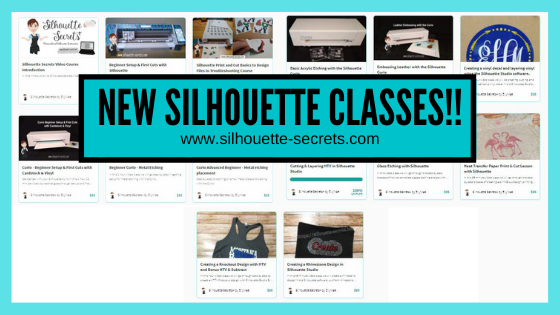
If you are looking to expand on your Silhouette skills and want to dive in and learn from all of my testing and tricks, check out the rest of the Silhouette courses available:

Silhouette Beginner Setup & First Cuts
Silhouette Print and Cut – Basics to Design Files to Troubleshooting
Curio Setup & First Cuts with Cardstock & Vinyl
Beginner Curio Metal Etching
Curio Advanced Beginner Metal Etching Placement
Basic Acrylic Etching with the Curio
Embossing Leather with the Curio
Creating a vinyl decal & layering using the Silhouette Studio software
Cutting & Layering HTV in Silhouette Studio
Glass Etching with Silhouette
Heat Transfer Paper Print & Cut Lesson with Silhouette
Creating a Knockout Design with HTV & Bonus HTV & Subtract
Creating a Rhinestone Design in Silhouette Studio

All of these are designed as step-by-step classes that are taught just like an in-person lesson.

The more you get into Silhouette and start playing with it the more you will pick up. Sometimes it can be overwhelming and testing can take a long time to get it just right. Let’s take that anxiety out of your Silhouette projects and get started!

For more information and to see each class details – CLICK HERE.

I would love to see and hear about what you are creating on my Facebook group at 
Silhouette Secrets with EllyMae.

Save this for future reference by pinning the image below.

Enjoy!

This image has an empty alt attribute; its file name is logo.jpg

THANK YOU for your support! How can you help? Click HERE & buy a coffee.
Every little bit helps with the cost of running the site.

Or if you are looking for more in-depth, step-by-step classes, check out all of my online Silhouette classes on my Teachable site HERE.

SS Logo snip it
**This post may contain affiliate links. What that means is that I may receive compensation if you purchase through the links I have provided. The price you pay for the product or service is not higher but I may get compensated for sharing.
Posted on 3 Comments

New Silhouette machine released – Portrait 3

Every year we hear about new machines or new products being released by Silhouette America. Usually we hear about the new released at the Silhouette Summit, however, this year is no ordinary year as we all know.
But that doesn’t mean that there is no new news.

Today is the day for the release of the new Portrait 3.

Affiliate links may be present in the following blog post and as an Amazon Associate I earn from qualifying purchases.

What is new with this machine?
Here is the official information:

Silhouette Portrait® 3
The Silhouette Portrait® is our smallest desktop cutting machine. It’s perfect for cutting materials up to 8 inches wide and
up to 60 feet long. The Portrait is ideal for cutting any letter- and A4-sized materials like paper, cardstock, and sticker
sheets as well as longer rolls of material, like vinyl or heat transfer. The Portrait 3 was built with ease and portability in
mind. Take it with you on the go for whenever creativity strikes!
Machine features include:
• Cutting width of up to 8 inches
• Cutting length of up to 12 inches (with a cutting mat) OR up to 60 feet (with select rolled materials)
• Matless cutting capabilities (see Tech Specs for full details)
• Automatic tool detection
• Print & Cut registration capability
• PixScan™ compatible
• 2 mm clearance for thicker materials
• Connect via USB or use Bluetooth® for wireless connectivity
• Driven by Silhouette Studio®, giving you limitless design options

This would be a great machine if you are wanting to travel with.

Here is a comparison to the other Silhouette machines

Check out this new machine HERE and use code SILSECRETS to be one of the first to grab it.

In addition to the new machine release there are also several bundles available and 40% off adhesive vinyl as well.

Portrait Basics Bundle $45.96 $25.99

– Portrait Cutting Mat (Standard Tack)
– AutoBlade
– Scratch-off Sticker – Printable
– Sticker Sheets – Rose Gold Foil

Sticker Bundle $37.46 $25.99

– Sticker Sheets – Clear
– Sticker Sheets – White
– Sticker Sheets – Silver Foil
– Washi Paper Sheets
– Sticker Sheets – White Glitter

Specialty Media Bundle $51.95 $29.99

– Temporary Tattoo Paper
– Scratch-Off Sticker – Gold
– Shrink Plastic – Clear
– Magnet Paper – Adhesive
– Stencil Sheets – Adhesive

These sales run from 8/21 to 8/31.

I always love to see what new & exciting things are coming.

Don’t forget to use my Elite Affiliate code SILSECRETS to get these specials.

Portrait 3 tip:
Make sure to add in the Silhouette adapters for the new tool housing to your purchase so that you can use other blades in the Portrait as well as the Autoblade.
The Portrait 3 only comes with the blue sketch pen adapter.
However, they are planning to release new tools that fit in the housing without the adapters – look for more information on that soon.
But for now, grab the adapters so you can use other blades as well.

No matter what Silhouette machine you have, I would love to see what you make!
Feel free to post photos or questions on my Facebook group at 

Silhouette Secrets with EllyMae.

Save this for future reference by pinning the image below.

Enjoy!

SS Logo snip it
**This post may contain affiliate links. What that means is that I may receive compensation if you purchase through the links I have provided. The price you pay for the product or service is not higher but I may get compensated for sharing.
Posted on 1 Comment

Let’s Explore – 3-D designs with Silhouette

I love creating 3-D design with Silhouette!
However, taking a 2 dimensional cut file and then assembling it into a 3-D project can be a bit intimidating. And I’ll tell you that for anyone, even experienced users, not all projects work the same each time. But, I’ll show you a few tips on how I assemble a design today.

Affiliate links may be present in the following blog post and as an Amazon Associate I earn from qualifying purchases.

First, let’s start with the design. I needed a small pinecone for a project, so I chose this Pinecone 3D Miniature file by Snapdragon Snippets – Design #279267.

The first thing I do is look to see if the designer has included a link to instructions for the file. Not all designers do, but in this case, there is an instructions button to click on.
Find those instructions HERE.
The link includes instructions for several of the 3D files that can be combined to make up a whole decor project. Today, I am just using the pinecone, so I scrolled down to those instructions.

I assembled the original pinecone exactly as those instructions showed.

But, I need my pinecone to be a LOT smaller. At first, I was feeling bummed that it wasn’t going to work for my project. Even though this design turned out exactly as it was supposed to, it didn’t work for my purpose. I just wasn’t sure that I could make it smaller and still get it assembled properly.

What did it take to change my mind? A quick discussion with my husband, 1 comment from a member of my Facebook group, and a nights sleep – where all I did was think about this project. By the next morning, I was itching to try it again.

One of the great features of the Silhouette software is the possibilities are pretty much endless! Want a smaller design, no problem!

Using the Scale option, I can take the original design and decrease the size. I knew I needed small scale, so I tried 33% of the original size. This is found under the Transform Panel – Scale Tab or at the top of the software in the Quick Access Toolbar.

For the “baby” miniature pinecones, the center stem and the spacers were not going to work or be needed at that size. I right clicked on the design and ungrouped it, then deleted the pieces I did not need to cut.
Make sure to delete the numbers and text that is not needing to be cut.

With all the numbers and text removed, I moved the pieces around on the cutting mat to cut out of cardstock.

Then I cut this out of a brown cardstock using the Cardstock Textured setting. I find this works well for me on almost all cardstock. I do prefer to cut smooth cardstock as textured can be a bit of a headache.

Check out this video on cutting and then assembly of the pinecone at 33% of the original size.
Note the video speed has been increased for cutting and assembly.
More tips following the video.

Tips for cutting & assembly

Cut the cardstock down to size.
I use a paper trimmer to cut all my materials down to size, so then I am only using the adhesive under the area of my design and not peeling a full sheet of material from the cutting mat. I find that this saves my adhesive on the cutting mat and makes my mats last longer.
More tips to getting the most out of your cutting mats HERE.

Adhesive
The right adhesive can make all the difference!
For the original 3-D Pinecone Miniature Design, I used a clear, liquid glue called Liquid Glass.
But, for the file reduced to 33% of the original size, I used hot glue. This helped for both adding a little bit of space between the layers to give the “baby” pinecone dimension as well as gluing it together.
When using the hot glue, thread the piece onto the wire first before applying the glue or it can cool before you get it in place.
I bought this fine tipped SureBonder hot glue gun and love it.

This fine tip glue gun made the “baby” pinecones achievable.

Sticky cutting mat
If your finding that cuts are not connecting or pieces are peeling up, you might want to try a new cutting mat after desticking it a bit.
You will notice in the video above, that I had 2 spacers that did not cut right and it was because my mat was very well used and the cardstock did not stay stuck down.
I find that this can be a big issue when cutting lots of cardstock.
While my mat may “feel” sticky to me, it may not be good enough to hold down all the pieces of the cardstock while it’s being cut, in order to connect the cuts.
If that cardstock moves at all, it may lead to a mis-cut.

Recut pieces as needed
To follow the sticky mat, you may need to re-cut a piece or two here and there. That is not a bad thing. I just copied what I needed and moved it to a new area on my cutting mat and re-cut it. I did cut a couple extra… just in case!

Don’t give up!
If you have never done a 3-D design before – try it out!
If you have tried one and it didn’t work out – try again!
I will fully admit that the first one I made, turned out great, but it was too large for what I needed. It took a little advice & rethinking to reduce the size and alter the design for my purpose.

Here are the babies.
This is the original 3-D Miniature Pinecone file reduced to 33% of the original size.

3-D Miniature Pinecone by Snapdragon Snippets
Evergreen Sprigs by Snapdragon Snippets

And here is the original 3-D Pinecone design along with the “babies”.

I have a very special project for this coming up and cannot wait to show you.
Stay tuned for that!

The Silhouette Design Store has an entire section dedicated to 3-D designs. Keep in mind, just like any site you get files from, some are more complex than others.
There are some that even as an experienced paper crafter, I have yet to tackle.
One of these days I will conquer this LowPoly Paperman, but for now, he will stay on my future to-do list. The biggest thing that these designs take is … time.

Want a few suggestions to get started on 3-D files?

Try a rolled flower such as Design #225639 by Lori Whitlock.

Check out this tutorial on Lori Whitlock’s site for tips on assembly HERE.
I find the first time you do this, you may not think you like it, but the more you do it, the better it gets.

Another flower type is one that the petal layers are stacked on each other, like this
Poppy Flower by Echo Park – Design #249937.

A Favor Box by Lori Whitlock – Design #237376.

Or a layered card like this Dragonflies Shadow Box Card by Carina Gardner –
Design #320338.

Whatever you choose to get started, just get started!
And I would love to see what you create.
Feel free to post photos or questions on my Facebook group at 
Silhouette Secrets with EllyMae.

Save this for future reference by pinning the image below.

Enjoy!

SS Logo snip it
**This post may contain affiliate links. What that means is that I may receive compensation if you purchase through the links I have provided. The price you pay for the product or service is not higher but I may get compensated for sharing.
Posted on 13 Comments

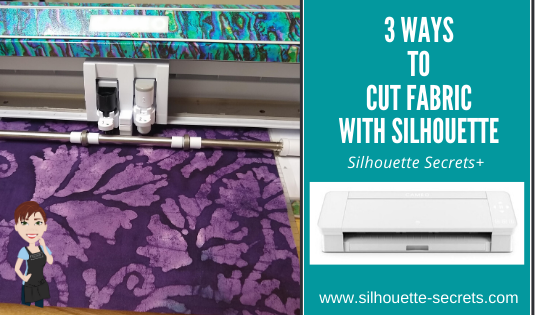
3 ways to use your Silhouette to cut fabric

Silhouette Secrets+ with EllyMae

Today we are going to look at 3 different ways you can cut fabric using your Silhouette machine. The technique that you use may vary depending on the easiest to use and also which Silhouette machine you currently are using.

Affiliate links may be present in the following blog post and as an Amazon Associate I earn from qualifying purchases.

For this post, I am a face mask file that was in the Silhouette Design Store.

Once you have the file, open it in the Silhouette software.

Use the Transform – Scale Panel to size the pattern to what you need by entering the exact percentage to size the pattern up or down.

Now, let’s take a look at 3 different options you have for using the Silhouette to make these fabric masks.

Option #1 – Cut a template with the Silhouette.

I used the Face Mask Sewing Pattern file to cut a template out of cardstock.
I then labeled each panel for future use.

I was cutting several of the same fabric, so I could layer the fabric and cut through multiple layers with a hand held rotary blade.

If you are using this method, you only need to cut 1 of each panel for the template.
I folded the fabric over several times to get both sides and then pinned the template to the fabric. I was able to cut the outer panel for 2 masks of each size.
You could cut more at the same time depending on how much fabric you have and how many masks you want.

I did the same with the Liner fabric.

I found this way to be the fastest way as you could cut multiple layers of fabric at the same time. You could also cut with scissors around the template if you don’t have a hand-held rotary blade.

Option #2 – The Cameo 4 with the rotary blade

If you have a Cameo 4, Cameo 5, or Curio 2 you have the option of using the Rotary blade in the Tool 2 housing. The Rotary blade is only compatible in the Cameo 4 machine.
*Updated to include new Silhouette machine models compatible with rotary blade.

You will want to use a super sticky cutting mat to hold the fabric in place.
A strong grip mat will work well or grab a brand new regular cutting mat.
A brayer is also a good idea to roll over your material to make sure it is good and stuck to the cutting mat. In order for it to complete the cut, the fabric needs to stay stuck to the mat.

For more tips on using the Rotary blade check out this post –
First Cuts with the Rotary blade.

Option #3 – Stabilize the fabric and cut with a new sharp blade.

Stabilized fabric can be cut with the Cameo 3 Autoblade, Cameo 4 Autoblade, Black Silhouette blade, Premium blade, or even the Deep Cut Blade
(although I wouldn’t recommend the Deep Cut as a first choice).

What is stabilized fabric?

Stabilized fabric means that you have applied something to it to help “stabilize” it or make it stiffer.

My favorite method is using Terial Magic and this is what I used in this tutorial.

To use Terial Magic, spray the entire fabric down with the solution.

Let it dry for 20-40 minutes.
Don’t get rid of those hangers from clothes you buy – they work perfect for projects like this or hanging swim suits to dry.
Then press it with an iron to dry completely.

This makes the fabric stiff and almost like paper.
Now, with a sharp Silhouette blade, it will cut like butter.

I used the Fabric, Cotton Print setting with a Black Silhouette blade, also called a “ratchet” blade.
The pattern above is enlarged 115% for the Large size.

Look at those nice, crisp cut edges.

Perfect cuts each time!

I do have to say, this is my favorite way to cut fabric with the Silhouette machines.
It will work on all Silhouette machines with a regular, sharp blade.

It does require pre-treatment, but it is so worth it for the end result!

The other awesome thing about Terial Magic, is that it washes out, so it is perfect for applique, quilting, or these fabric masks.

Another alternative to Terial Magic is Heat and Bond sewable.

You do not want to use a product like starch or other stabilizers that are not sewable, or you may gum up the cutting blade.

For this design, once it was cut, I followed the step-by-step tutorial on the Silhouette 101 blog for assembling this face mask.

I am not an expert at sewing. Basically, I can sew a straight line.
And I used a basic Brother sewing machine to finish these masks out while following the tutorial on my ipad.

So grab your favorite fabric and create something!

Go MSU Bobcats!

And then try to get a photo where your kids aren’t acting up.

See that sideways Momma look?
This was not the first take on the photo – lol.

What will you create with your Silhouette machine?
My kids are already requesting more masks in other fabric patterns and shirts too!
Stay tuned for more on that!

Additional Resources:

Save this for future reference by pinning the image below.

Enjoy !

THANK YOU for your support! How can you help? Click HERE & buy a coffee.
Every little bit helps with the cost of running the site.

Silhouette Classes

Never stop learning! Let me help you take the anxiety out of learning with Silhouette and get to creating faster! My Silhouette classes are heavily focused on software, so you can take the skills & techniques taught and apply them to many future projects!

Silhouette step-by-step Classes by Silhouette Secrets+

Silhouette Secrets+ with EllyMae

**This post may contain affiliate links. What that means is that I may receive compensation if you purchase through the links I have provided. The price you pay for the product or service is not higher but I may get compensated for sharing.

Posted on 4 Comments

Print and Cut with Heat Transfer Paper

Print and Cut with Heat Transfer Paper

*This post may contain Affiliate links.

For the June 2019 All Things Silhouette Conference, I taught a class called “Let’s Explore Print & Cut with Printable Heat Transfer”. I had so much fun creating this class and want to share that with all of you. While I cannot pass around all the demos I made like I did in class, I hope a photo blog post will do.

Silhouette_Secrets+PNC

First, I set up the Print & Cut design using the Summer Flowers bundle by Echo Park – Design #186925 from the Silhouette Design Store.

PNC Set up copy

When setting up a Print & Cut project, I follow the same steps each time. In this post – Print & Cut – Part 3 – Images, I go through every step I take to set up the file for the best success.
This is what I would also recommend for a beginner who is doing this for the first time or for anyone who is having issues with the Print and Cut not registering or not cutting accurately.
While you can adjust several things on a Print & Cut file, I find most users get the best results and have less headache if they first start with a baseline
For more troubleshooting tips, see this post – Print & Cut – Part 1.

This is exactly what I walked through in class step by step.

Now to the fun part, Show & Tell!

This class was sponsored by Specialty Materials and I used a product called Colorjet III Light and Dark Heat Transfer Paper. ColorJet III comes in packages of either 8-1/2″ x 11″ or 11″ x 17″ sheets. I loved the 11″ x 17″ sheets with my Canon TS9521C large format printer, then I could fit several print and cut projects on one page and do larger designs as well.
You can request a free sample on the website HERE.

First, I started with a few shirts.

Unicorn tshirt

As soon as this shirt came off the press, it was my 6 year old daughter’s favorite shirt.
I had to go searching for it in order to take it to the ATS Conference with me.
I used Colorject III Dark on this shirt with a design that is part of a print & cut sticker file called ML Unicorn Cute Stickers by MiniLou – Design #285420 from the Silhouette Design Store.

Now, if you read the directions on the Colorjet III it says “Care – Hand wash and air dry. Do not dry clean. No bleach or aggressive detergents” (Specialty Materials) but, I have 3 kids and “hand wash” does not really happen in my house. But, I am happy to report that it has been through the washer & dryer at least 3 times since I made it and it still looks great. And I brought it with me to Conference to show everyone how it held up.
What do I recommend? You have to test it yourself! The manufacturer gives you care instructions and for best results, I’d recommend those to get the most life out of it.
Me….. well, you guessed it. I throw everything in the washer & dryer with the thought that I can always remake it if I need to.  That is probably not the best advice for everyone.

IMG_20190327_154041760_HDR
I used the Colorjet III Dark on this blue shirt with a design called Justice League by DC Justice League – Design #201137.
*This is an older design that is no longer in the Silhouette Design Store.

IMG_20190524_100919036
For this shirt, I used the Colorject III Light with designs Painted Purple Bouquet by Loni Harris – Design #139067 and the words are cut with Siser Easyweed HTV using the Live Life in Full Bloom by Silhouette – Design #129071.

And then I moved on to other objects and things I could find that wouldn’t necessarily need to be washed often.

eZy_watermark_31-05-2019_04-31-15
This one is using the Colorjet III Light pressed onto a Canvas panel & framed. Created with Enjoy Today Painted Floral by Loni Harris – Design #134285 from the Silhouette Design Store.

eZy_watermark_31-05-2019_04-31-34
Here is another one created with Colorjet III Light then pressed onto a Canvas panel & framed. Created with Floral Monogram K by Angie Makes – Design #173599 from the Silhouette Design Store.

IMG_20190330_101825027
This time, I used a framed canvas and the Colorject III Light. In order to get a good pressure on the framed canvas, I had a wood board cut to fit in the back side of the frame and placed it inside when I pressed the design. I’ve been eyeing these watercolor designs and love that I’ve found a way to use them. This was created with Multicolored Prism Heart by Rhonna Farrer – Design #248413 from the Silhouette Design Store.

IMG_20190330_101856280
This is using Colorjet III Light on a zippered cotton canvas bag from Craft Chameleon. It  was created with Watercolor Heart by Rhonna Farrer – Design #248434 from the Silhouette Design Store.

eZy_watermark_20-05-2019_03-56-10 copy
I used Colorjet III Dark on this garden flag from Craft Chameleon for the American Flag of United States by Echo Park – Design #269732 (Silhouette Design Store). The words are cut with HTV and I used a design by BasicGrey called Home of the Free Because of the Brave – Design #204727.

And now some of my favorites – photos!

 This one should be hung on my wall for many years to come, memorializing that I managed to get all 3 of them smiling together without some crazy face.

eZy_watermark_24-05-2019_10-16-45
I used the Colorjet III Light printed through the Silhouette software on a canvas panel, which I then put in a 8″ x 10″ frame. While these are not UV treated like others you get at a professional photo shop, you can change the photo out each year or several times a year if you like for a lot less expense. I love having options!

eZy_watermark_24-05-2019_10-18-04
Another photo on a canvas panel using Colorjet III Dark.

And what about a one of a kind gift?

eZy_watermark_24-05-2019_10-16-06
I used Colorjet III Light to add my favorite photo to a canvas tote bag from Craft Chameleon.

Now, did all of my test projects turn out? No, they did not. And that is what comes when developing a class for an event. There will be things that work and things that don’t. But, even the things that don’t turn out are all learning experiences.

IMG_20190618_120525499 copy

Here are a couple of projects that didn’t turn out quite as I expected them to. I always recommend reading the instructions for any brand of product you are using. In those instructions for the Colorjet III it states “Be advised that dye migration has occurred with low energy dyes in polyester and poly-blend fabrics.” What does this mean?
This means to test it and that not all fabrics may work as you want them to. Not because of the product but because you cannot always predict how the dye in a material is going to react. For instance, if you have white HTV and press it on a red shirt, the white HTV may look pink. This is dye migration.

In the case of the apron and the sleeping mask above, the color of the fabric came through the Colorjet III Dark, even though I used the correct material. I tried, it didn’t work. I moved on to another project.

The zippered canvas bag on the right side, is an example of using the Colorjet III Light on a dark fabric. Complete user error on this one as I just wasn’t thinking when I grabbed my blank to press it on to. My daughter still loves it and now it’s her “money bag” she says.

I hope this post has given you some new ideas to use in your creations with Heat Transfer paper. It’s not just for shirts anymore!

A big thank you to Specialty Materials for sponsoring my class at the June 2019 All Things Silhouette Conference! For more information on future check out Terri Johnson Creates blog and click on the Events tab.

PNC Heat Transfer

I would love to see what you create – feel free to post on my Facebook group at
Silhouette Secrets+ with EllyMae.

Enjoy!

SS_Signature copySS Logo snip it

**This post may contain affiliate links. What that means is that I may receive compensation if you purchase through the links I have provided. The price you pay for the product or service is not higher but I may get compensated for sharing.

Posted on 3 Comments

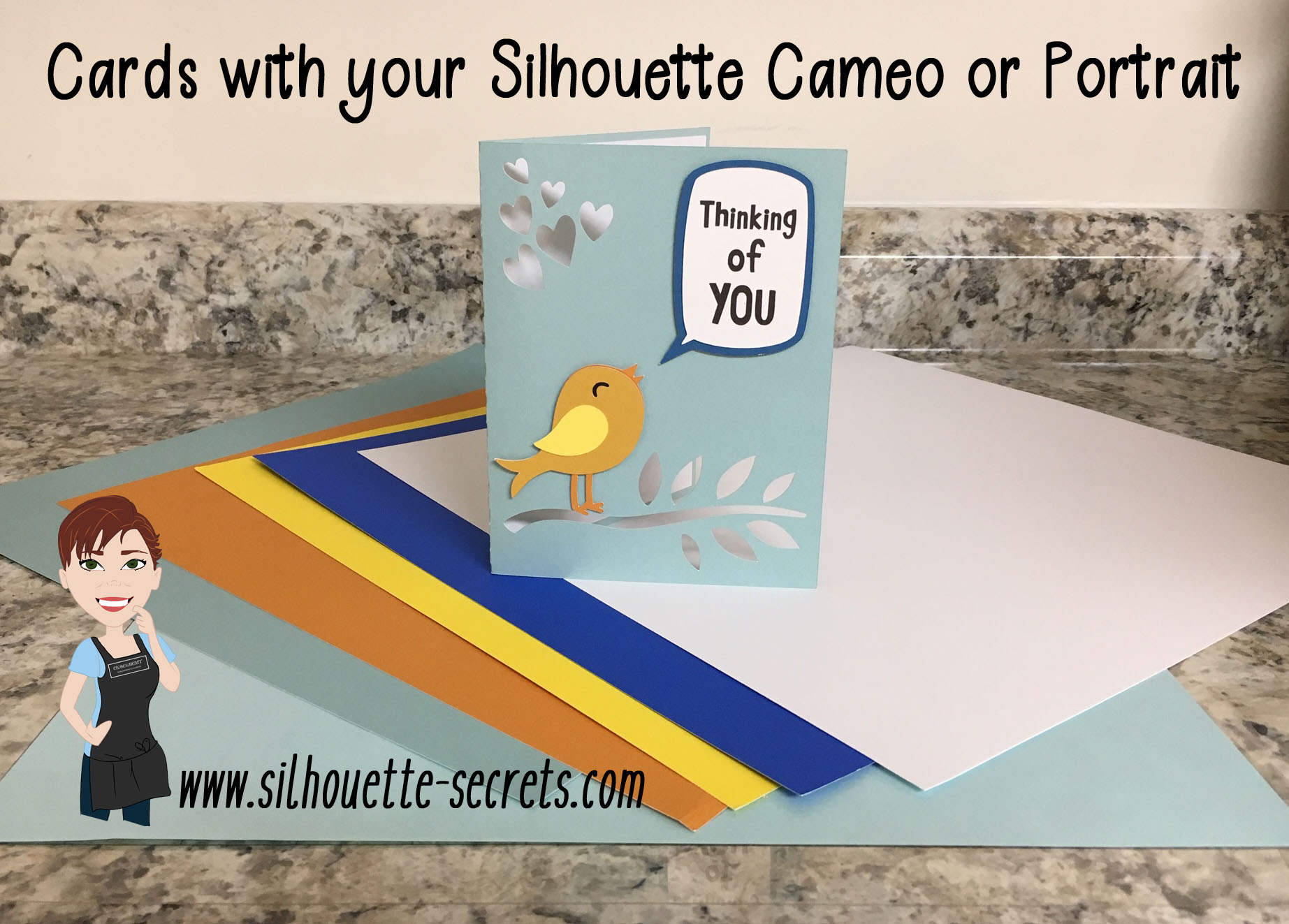
Cards with your Silhouette

Did you ever need a quick card?

Grab that cardstock and an easy cut file from the Silhouette Design Store.

img_7960 copy

I used Lori Whitlock’s Sympathy Card Thinking of YouDesign #258278. While the card says Sympathy, it could be used for a lot more than that. This was a pretty easy card to cut.

Open the Design and right click to ungroup the pieces.

ungroup

Next, move the pieces around on the mat and place the cardstock in the same location of the mat.
To see how I did this with Oracal vinyl as well, check out this post on the Acrylic ornaments HERE.

moving pieces copy

Tips

 – I use the Reveal Mat and increase it to 100% to see the grid lines of my cutting mat, so I can line up the material in the exact location and cut it down to the size needed with my paper trimmer.

– A sticky mat is important to hold down the entire piece of cardstock so it does not move while it’s being cut. A mat that is too sticky will hold the paper too tight and make it harder to get it off after it’s cut. De-stick your mat a few times on a clean cotton t-shirt or towel. I usually use my t-shirt I have one, as that is the quickest.
A mat that is not sticky enough and the paper is not held down for a crisp cut.

– I use the textured cardstock setting for almost all cardstock and it works well. It will lightly score the mat, but that is normal as you are cutting completely through a material.

– I like the cardstock packs from Michael’s to test and play with cutting cardstock. It cuts well and is inexpensive to play around with. I do prefer to cut smooth cardstock versus textured. I just found that there was more chance for a cut to not connect with the textured – again a really sticky mat will help with this and holding that textured cardstock in place.

– Play, play, play and you will pick up tricks and tips. Even experienced users still have issues, so if you do, it is all part of the process.
Keep on trying!

img_7962 copy

And use a bit of adhesive and you are finished.

You can get as detailed in card making as you want or as simple.

I would love to see what you create – feel free to post on my Facebook group at
Silhouette Secrets+ with EllyMae.

Enjoy!

SS_Signature copySS Logo snip it

**This post may contain affiliate links. What that means is that I may receive compensation if you purchase through the links I have provided. The price you pay for the product or service is not higher but I may get compensated for sharing.