Posted on 29 Comments

Let’s Explore v4 – Modify Panel – Part 1

The Modify Panel has lots of neat tools in it that perform a variety of functions. It can be found on the right side of the Silhouette Studio v4.

Modify Panel v4

Let’s take a look at all the tools in this panel.

Modify Panel details copy

  1. Weld – Joining two or more objects that are overlapping together to form 1 object. This is often used with text when you want it to cut as one solid design vs individual letters.Weld3You will notice that the top text, the red lines from the characters overlaps the letter next to it. If you sent it to cut like this, it will cut out the red lines exactly how they show, so your letters would have cuts through them.Weld - zoom copyBy choosing to weld the font first, you can join the letters together so it cuts as one smooth piece. After you have welded, any piece of the text that is not overlapping will now be a separate object – like the dots of the i, so you want to make sure to Group them together to keep the text moving as one design. When you weld text, it does change it from editable text to a vector image, so make sure to make a copy & pull it off to the side so you have the original in case you need to go back.
  2. Subtract – Takes the top layer and subtracts it out of the bottom layer under it.SubtractOn top is the original design. Mom is typed out and behind the names. When you select both designs and choose Subtract, it subtracts out the names (top layer) from the Mom design (bottom layer). This works well for things like layering HTV where you don’t want the bulk of layering on your shirt or if you are using glitter HTV that is not recommended to be layered. Tip: with this design, I would create an offset of the original names and then use the offset to subtract from the Mom design. It gives you a little more flexibility in placement when you apply it to the shirt. Offset copy I used a 0.20 offset on this design. Then moved the original name text away and used the Mom (bottom layer) and the offset (new top layer) to Subtract. Offset demo Since I used an offset, this will allow you to place your names text inside of the area when applying the HTV and you won’t have to worry as much about shrinkage and getting it perfect. Offset final Move the name text back on top of your Subtracted design to get an idea of how it looks. On the top design, you have to get the exact placement of the names lined up with the bottom layer. On the bottom design, you will notice there is a bit of white showing around the name text, this will be beneficial when you are applying HTV so you don’t have to worry as much as about the HTV shrinking when you press each color. temp_1 I used MF I love glitter font by Misti Fonts and Gulana font. Keep in mind if you plan to sell creations with these fonts, you will want to purchase the Commercial License for each. If you are using adhesive vinyl, it is not as much of an issue because there is no shrinkage. But, you will still need to get it lined up perfectly and layering marks can help with that – check out how to do that HERE.
  3. Subtract All – This option removes any part of an design that is behind another design. I always start my pulling off a copy of my design to the holding area off the mat, so I can go back to the original if needed.Subtract All So above I drew a heart and moved it behind my Mom and name layers. Make sure to align the design how you want and then I chose Subtract All and it cuts out the top 2 layers from the very bottom layer (heart). This works great for making designs that you don’t want to have the bulk of materials overlapping. Again you could use an offset to help with ease of getting it lined up and not worrying about shrinkage.
  4. Intersect – When 2 or more designs are overlapping, this will keep only the part of the design that is intersecting between the designs and the rest is deleted.Intersect
  5. Divide – When 2 or more designs are overlapping, this will divide any parts that are overlapping, but keeps all of the pieces on the design mat. Nothing is deleted.Divide
  6. Crop – This will allow you to crop a shape out of a pattern, design or in this case a photo.CropDraw a heart over the photo, select both the photo and circle, then choose Crop and it will take that shape out of the layer under it.

There are so many neat things you can accomplish with these tools under the Modify Panel. I encourage you to draw some shapes, pull in some patterns and just play around with them to see what they do.

Save this for future reference by pinning the image below.

Pin - Modify Panel - Part 1

Find Part 2 of the Modify Panel HERE – Compound Paths & Detach Lines

So far in the “Let’s Explore v4” series we have covered: – Page Setup Panel – Tab 1 – Page Size, Cutting Mat, Rotate View, Print & Cut Borders – Page Setup Panel – Tab 2 – Grid OptionsPage Setup Panel – Tab 3 – Registration MarksFill Color PanelLine Style PanelTrace Panel – Basic TraceTrace Panel – Trace by ColorTrace Panel – Magnet TracePixscan PanelText Style Panel – Tab 1Text Style Panel – Tab 2 & 3 – Glyphs & Spell CheckTransform Panel – Align TabTransform Panel – Scale TabTransform Panel – RotateTransform Panel – Move ByTransform Panel – Shear byReplicate Panel – Tab 1 & 2Replicate Panel – Object to Path Whew! We’ve covered a lot!

I truly believe that if you learn how to create in the software, the possibilities are endless! The software is the key! And it is such a powerful program that is available for anyone to use.

I would love to see what you are creating or learning with your Silhouette! Feel free to post photos or questions on my Facebook group at Silhouette Secrets with EllyMae.

Enjoy !

THANK YOU for your support! How can you help? Click HERE & buy a coffee. Every little bit helps with the cost of running the site.

Looking for more in-depth, step-by-step classes, check out all of my online Silhouette classes on my Teachable site HERE.

SS Logo snip it

**This post may contain affiliate links. What that means is that I may receive compensation if you purchase through the links I have provided. The price you pay for the product or service is not higher but I may get compensated for sharing.

Posted on 12 Comments

Let’s Explore v4 – Replicate Object on Path

Replicate Panel – Object on Path

I am sure you have seen other projects where people had a design replicated multiple times in a shape and you’ve said “How did they do that?”

Well, today we are going to explore how to do that right in the Silhouette Studio v4.

The Replicate Object on Path tab can be found under the Replicate Panel on the right side and is tab 3 on the panel.

Replicate Object on Path copy

First add the design and the shape you want the design to follow onto the design mat.

For this design, I drew a heart using 2 circles and a square turned 45 degrees, then placed them overlapping and welded them. I resized the heart down to a manageable size. And then drew a perfect circle by holding down my Shift Key and dragging my Draw Ellipse tool out.

Replicate Object start

Now let’s take a look at the Object to Path tab.

Replicate Object detailed copy

  1. Show Grab Handle – Click on the Object you want to move to the shape to select it, then click on Show Grab Handle button in the panel. A grab handle will appear in the object and you click and drag that towards your shape.Show Grab Handle copyWhen you drag it on to the shape, it will replicate copies of that object around the shape. And you get another little circle (drag handle) on the shape to the right of the original object. By clicking and dragging on this drag handle you can increase or decrease the spacing between the objects on the path, this will also change the number of objects around the shape.

    *If for some reason the object will not snap to the path, try this – right click on it and choose Make Compound Path. Sometimes strange things happen and even though a design isn’t really a compound path at all, this seems to work to help it to decide it can snap to a path. 

    Drag to shape copy

    Here I moved the drag handle so there is more space between the objects. Notice that the numbers change on the panel as well under the Position.

    Drag copies copy

  2. Perpendicular – Change the orientation of the object on the path by leaving this box checked or un-check it to change the angle of your object.Perpendicular copy
  3. Start Angle – Change the rotation angle of your object on the path to an exact angle.Start Angle copy
  4. Increment Angle – Change how each object is placed in relation to the previous object. In this case, each heart is rotated 90 degrees from the previous heart.Increment angle
    This creates a pattern of your design around the shape. With this option, you can make many variations of the same design.
  5. Start Position – Change the position of the original object on the shape by changing. In this photo, I have changed the position to 0, which places the original object at the 3 o’clock position. You can also move the grab handle on the original object and move it manually too.Start Position copy
  6. Section Length – Changes the length between the beginning and end object on your path.Section Length copy
  7. Number of Repeats – Change the number of times the object is replicated on the path.Number of repeats copy
  8. Step length – Change the distance between each object on the path by adjusting this figure. This will change number of objects on the path.Step Length copy
  9. Release Copies – When the design is complete, click on this to release the objects from the path and remove the shape your were using as your path.Release CopiesAt this point, all of your objects are now single objects, as you can see by the selection boxes around each. I would suggest grouping these together before you go further, so you don’t accidentally move one.Release copies 2

And there you have the Replicate Object on Path – how cool is that?

What will you do with this neat feature?

Replicate final

Want to start at the beginning of the Let’s Explore v4 series – click HERE.


Enjoy !

THANK YOU for your support! How can you help? Click HERE & buy a coffee. Every little bit helps with the cost of running the site.

Looking for more in-depth, step-by-step classes, check out all of my online Silhouette classes on my Teachable site HERE.

SS Logo snip it
**This post may contain affiliate links. What that means is that I may receive compensation if you purchase through the links I have provided. The price you pay for the product or service is not higher but I may get compensated for sharing.

Posted on 4 Comments

Let’s Explore – Transform – Shear

Today we are on the final tab of the Transform Panel – the Shear tab. This Panel is available if you have the Designer Edition upgrade to the software.

This is another tool that is often overlooked. Why would you use it?

You can change the look of a basic shape, design or even font to give it a new look.

The Shear tab is found on the rights side of the Silhouette Studio v4 under the Transform Panel.

Shear Panel copy

Below I have a few examples of how you can use this tool to change the look for a font or design.

Shear examples

Let’s check it out and see some examples.

Shear Panel detail copy

  1. Horizontal Shear Preset- Shear or skew by preset degrees on a horizontal line – choose between -30, -15, 0, 15, or 30 degrees.Horizontal Preset shear
  2. Horizontal Custom – Shear or skew by typing in a custom number and it will shear to that degree on the horizontal line.Custome Horizontal shear
  3. Vertical Shear Preset – Shear or skew by preset degrees on a vertical line – choose between -30, -15, 0, 15, or 30 degrees.Vertical Shear Presets
  4. Vertical Shear Custom – Shear or skew by typing in a customer number and it will shear to the degree on the vertical line.Vertical Shear Custom
  5. Show Shear Handles – Check the box to show the Shear Handles that you can grab and skew your design manually instead of putting in a certain degree designation.Show Shear Handles copy

This can make the designs or shape you have in your library go a lot further when you know that you can manipulate and change them.

For instance, I took 2 basic shapes and created this rough sun design.

Sun demo

By cutting a circle in half, I created the main sun part. Then I took a rectangle and used the Shear Handles to manipulate each copy of the streaks.

Want to give your signature a more realistic slant to how it would be written?

Signature shear

Do you have a font that does not have the Italic option? Then create your own.

Italic demo

Whether you are creating your own designs or just want to play around, the Shear tool is definitely something to play around with.

Enjoy !

THANK YOU for your support! How can you help? Click HERE & buy a coffee. Every little bit helps with the cost of running the site.

Looking for more in-depth, step-by-step classes, check out all of my online Silhouette classes on my Teachable site HERE.
SS Logo snip it

**This post may contain affiliate links. What that means is that I may receive compensation if you purchase through the links I have provided. The price you pay for the product or service is not higher but I may get compensated for sharing.

Posted on 38 Comments

Let’s Explore v4 – Scale tab

Welcome back to Let’s Explore v4!

Today we are on to Tab 2 of the Transform Panel – the Scale tab. This is another tool I use almost every time I open my Silhouette program.

Just like almost all the other tools, there are many ways to do things in the software. While you can grab the corners of the Selection box and drag your design to the correct size, sometimes you need a more accurate measurement of your design.

Selection box copy
*I Craft Therefore I Hoard Phrase by Kolette Hall Design #152410

For instance, I am making these stencils for my husband to use in a woodworking project and he wants a maximum of 6.5 inches for the design, so it fits on the board he has. With the Transform Panel, it is possible to achieve this easily.

Stencil demo copy

Let’s take a look at the Scale Tab.

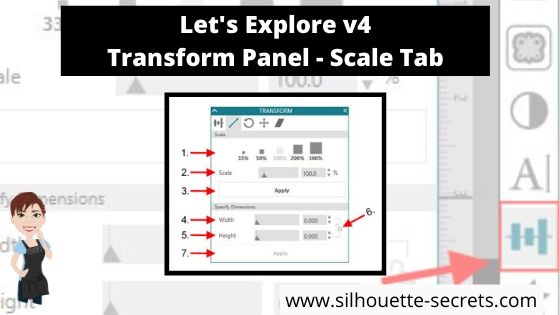
Scale tab details copy
  1. Scale by percent – There are a couple of preset percentages that you can choose for quick resizing of an object. Anything below 100% will decrease the size and higher than 100% increases the size.
    Scale percent
  2. Adjustable Scale – Highlight the number in the box and choose your custom percentage to resize the design.Resize custom percentage copy
  3. Apply – After changing the customized Scale option, click Apply (or hit Enter).
  4. Width – Highlight the numbers and replace or use the increase/decrease arrows  to a specific dimension.
  5. Height – This works the same as the width, highlight the numbers and replace or use the increase/decrease arrows Arrow up down copy to a specific dimension.
  6. Lock Aspect – This is a very important icon! The default is set to the unlock position. If you want to keep the proportions of a design the same when you resize it, click this icon to change it from unlocked Unlock copy to locked Locked copy.
    Specific dimensions copy

    What does that mean? If I change the Width of my design while it is unlocked, then it will adjust only the width of the design and I end up with some distorted shape the design. You can see here that now my state of Montana design, does not look how it should.Lock AspectVersus if I click on the Lock Aspect and lock it in, then it will adjust both the width and the height, keeping the proportions the same.

    Locked Aspect
    That makes quite a difference in the design.
  7. Apply – After making changes to the Width and Height you can click on Apply or hit Enter for the software to make the changes.

And now you have a better understanding the Scale Tab found under the Transform Panel in Silhouette Studio v4.

You can also find some of these tools in the QAT (Quick Access Toolbar) at the top of you program when your design is selected. How it appears on your screen, will be dependent on your screen size and you will notice that each person’s varies for that reason.
Some of the tools will have a fly out box and others will be fully visible as my width & height are.

QAT copy

I hope you take a few minutes to check out this Scale panel and see what it’s all about!

Check out the other posts in the Let’s Explore v4 Series HERE.

Save this for future reference by pinning the image below.

I would love to see what you are creating with your Silhouette! Feel free to join my Facebook group – Silhouette Secrets+ with EllyMae and share!

Enjoy !

THANK YOU for your support! How can you help? Click HERE & buy a coffee.
Every little bit helps with the cost of running the site.

Looking for more in-depth, step-by-step classes, check out all of my online Silhouette classes on my Teachable site HERE.

SS Logo snip it
**This post may contain affiliate links. What that means is that I may receive compensation if you purchase through the links I have provided. The price you pay for the product or service is not higher but I may get compensated for sharing.

Posted on 37 Comments

Let’s Explore v4 – Transform Panel – Align

Today we are exploring the Transform Panel – Align Tab.

This is a very important and useful panel when you are creating designs & one I use almost every time I open the Silhouette software.

Transform Panel copy

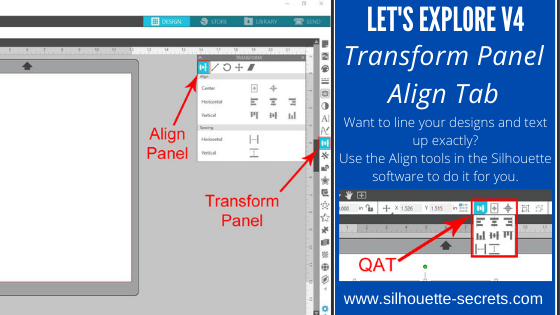
The Transform Panel is on the right side of Silhouette Studio v4 and the first tab on this panel is the Align Tab.

Let’s take a look at the entire Align tab.

Transform Panel details copy

  1. Center – This icon  Center to Page icon copy is the Center to Page and it will center the design in relation to the Page Size you have set under the Page Setup Panel – Page Size. Here I have resized my design (Softball Mom by SM Designs) and then hit the Center to Page icon and it centered that to my 12″ x 12″ page size.Center to Page demoThen you have the Center multiple objects copyCenter multiple objects icon. When multiple objects are selected, this will center those objects to each other. If I draw a circle and select both objects, click on the center multiple objects, it will center those designsCenter multiple objects demo
  2. Horizontal – There are 3 options here: (A) left edge, (B) center, (C) right edge.Horizontal Alignments copy (Dots Nice – A Dotty Handwritten font by One Oak Designs)
  3. Vertical – There are 3 align options here: (A) top, (B) center, (C) bottom edge.Vertical Alignment copy (SG Beach Vacay Dingbats Font by Sophie Gallo – Design #240727)
  4. Horizontal Spacing – With multiple objects selected (more than 3), this will space those objects equal distance apart horizontally.Horizontal spacing copy
  5. Vertical Spacing – With multiple objects selected (more than 3), this will space those objects equal distances apart vertically.Vertical spacing copy

And there you have the details of the Align tab in the Transform Panel of Silhouette Studio v4. Now, there is no need to eye-ball the spacing or alignment, let the software do the work for you.

You can also find the same icon in the Quick Access Toolbar (QAT) at the top when more than one object is selected.

QAT Align2

Check out the other posts in the Let’s Explore v4 Series HERE.

Save this for future reference by pinning the image below.

Transform Panel - Align Tab Pin

I would love to see what you are creating with your Silhouette machine. Feel free to post on my Facebook group Silhouette Secrets with EllyMae. If you have questions feel free to post below or on the Facebook group too!

Enjoy !

THANK YOU for your support! How can you help? Click HERE & buy a coffee. Every little bit helps with the cost of running the site.

Looking for more in-depth, step-by-step classes, check out all of my online Silhouette classes on my Teachable site HERE.

SS Logo snip it

**This post may contain affiliate links. What that means is that I may receive compensation if you purchase through the links I have provided. The price you pay for the product or service is not higher but I may get compensated for sharing.

Posted on 7 Comments

Let’s Explore v4 – Text Style – Glyphs

Have you heard of Glyphs? These are special characters that some fonts have included with them. Glyphs can be flourishes, fancy letters, punctuation or characters with accents, shapes, etc.

Glyph

With the software Silhouette Studio version of v4.1.197 and the Designer Edition software upgrade, came the option to unlock the glyphs feature in Silhouette Studio. This is amazing as I had such a hard time with the small Character map on my PC.

Access the Glyphs panel on the second tab of the Test Style Panel on the right side of Silhouette Studio v4.

Glyphs panel copy

Let’s Explore the glyphs tab in the Text Style Panel!

Glyphs detailed copy

  1. Text Search bar – Just like on Tab 1,  the name of the font that is selected will appear in this box or you can highlight it and type a name in the box and it will select that font.
  2. Glyphs – This area is where you will see the glyphs of the font that you are using show up. Note: sometimes not all the glyphs will show up here and you will need to access those through Character Map (PC) or Fontbook (Mac).  It just depends on how the font was created.
  3. Recently Used Glyphs – This handy feature shows the ones you have recently accessed.
  4. Icon size – You can change the size of how the Icons appear in the glyphs panel. And when you hover over a glyph it magnifies it as well. Large vs small icons copy

Now, there is still 1 more tab option in the Text Style Panel and it’s a good one.

Spellcheck

If you type out a word that is either not in the dictionary or is not spelled correctly, you will see a green squiggly line show up under it. Here I’ve typed my business name with no space. That is not in the dictionary, so it let’s me know that.

Spell check copy

If I want to add that word to my dictionary, I can right click on it and choose “Add ‘SilhouetteSecrets’ to Dictionary”.

Add to Library copy

Once it is added to the dictionary, the green line disappears.

Added

So let’s explore the Spelling Panel.

Replace text copy

If you type out several words which are misspelled (which is very hard for me to do on purpose), you will notice the green squiggly lines under those that are not in the dictionary.

Click on Replace and it will pop up a list of suggestions to replace it with. Choose the one you want, click on Replace again and it will change it.

If you know the word is spelled correctly, choose Add to Dictionary and the green line will disappear. This word has now been added to your Silhouette dictionary.

The Arrows at the top of the panel are the Undo and Redo buttons, in case you picked the wrong replacement word, you can simply Undo it.

Undo Redo copy

And then you have some Advanced options.

Advance Dictionary copy

  1. Automatic Spellchecking – check it on or off.
  2. Select Language – Select your default language.
  3. Custom Dictionary – Any words you add to the dictionary will appear here.
  4. Text box – Type in a new word to add it to your dictionary.

If you ever need to delete a word you have added to the Dictionary, click on the word and the delete option will show up.

Dictionary delete

And there you have all of the Text Style Panel. Keep in mind that the Glyphs panel is an option available to you when you upgrade the software to Designer Edition or higher.

Check out the other posts in the Let’s Explore v4 Series HERE.

Enjoy !

THANK YOU for your support! How can you help? Click HERE & buy a coffee. Every little bit helps with the cost of running the site.

Looking for more in-depth, step-by-step classes, check out all of my online Silhouette classes on my Teachable site HERE.

SS Logo snip it

**This post may contain affiliate links. What that means is that I may receive compensation if you purchase through the links I have provided. The price you pay for the product or service is not higher but I may get compensated for sharing.

Posted on 14 Comments

Let’s Explore v4 – Trace by Color

Last week, we started with the Trace Panel – Tab 1 which covers the Basic Tracing options. Now, we are moving on to Trace Panel – Tab 2: Trace by Color. This option is available if you have the Designer Edition upgrade (DE+ or BE).

Trace Panel copy

While the Silhouette Studio Basic software is available for free, I do feel the Designer Edition upgrade is a great investment and will save you so much time in the long run. Silhouette America has provided a chart that lists out what features are unlocked with each upgrade and you can find it HERE.

Some of the biggest features for me that Designer Edition unlocks are: opening svg & pdf files, rulers, trace by color, rhinestone conversion and glyph access.  Even if you do not know what all of those do at this time, you will learn more as you utilize the software.

Now, let’s explore the Trace by Color Panel.

First, open a design to be traced such as a png or jpeg file. For this example, I am using a png file from Scout and Rose Design Co called Too Cute to Pinch.

Demo design

Trace by Color Panel copy

  1. Trace by color – Click on Trace by color and then choose the color you want to trace. I clicked on the pink color and it highlighted all the pink of the design in yellow. This is what it will trace.Trace by Color 1
  2. Solid Fill vs Outline fill – Solid Fill is shown in the photo above. Outline fill is shown below. This is a matter of personal preference on how you want it to show.Outline Fill
  3. Single Area or All Areas – In my original photo in #1, All Areas was chosen and that highlights all of the pink areas of the design. Single Area will allow you to pick & choose a certain area, such as individual letters,  that you want to trace.Single Area
  4. Tolerance – This can be adjusted to increase or decrease the area that is picked up in a trace color. In my example, when I click on the light green, it picks up the dark green as well in my trace.Tolerance 50 percentHere you can see that the Trace picks up all shades of green with a 50% tolerance. Tolerance 6 percentAnd when the tolerance is lowered to 6% it deselects the dark green shamrock and only picks up the light green color in the trace. You would trace the shamrock and change the tolerance to get it to trace as well.
  5. Trace – After you have the design highlighted that you want to trace, click on trace and it will change to red cut lines around the object selected. You can then move the cut lines off the design and I fill with color to see the design better.Trace option
  6. Trace & Detach – This will trace & detach the image from the background. If you are using a jpeg, this is a great feature.

Now, I have my final pieces that I’ve filled with color and can move them around on my mat to cut them and then place them on to my project.

Final trace copy

And now you can go play with the Trace by Color Panel. This can be a great option if you only have the graphic file for a design.

Check out all the other posts in the Let’s Explore v4 series HERE.

Enjoy !

THANK YOU for your support! How can you help? Click HERE & buy a coffee. Every little bit helps with the cost of running the site.

Looking for more in-depth, step-by-step classes, check out all of my online Silhouette classes on my Teachable site HERE.

SS Logo snip it

**This post may contain affiliate links. What that means is that I may receive compensation if you purchase through the links I have provided. The price you pay for the product or service is not higher but I may get compensated for sharing.

Posted on 47 Comments

Let’s Explore v4 – Fill Color Panel

Today we are going to explore the Fill Color Panel located on the right side of Silhouette Studio v4.

Fill Color Panel copy

I use this feature a lot when I design in the Silhouette software for many reasons. Now, understand that by filling a design with color, it does not cut in that color. The color you fill it with will be a visual reference only, unless you are making a Print and Cut project. If you are creating a Print and Cut project, then the colors will be a representation of what colors will print on your printer.

I fill my designs and fonts with color so I can visualize the design better. Typically, I just fill it with black, but if I’m creating a multi-color image, I can then choose the colors that will best match my design. Another reason to fill it with color is to be able to select the design or font easier. When an image is transparent, you have to click on the red outline of the image to select it, which can sometimes be difficult. However, if you fill it with a color, you can click anywhere on that color to select the object.

For today’s example, I am using a font from the new SoFontsy site called Wine Not and will be creating my own design.

Wine not design2

You can see in my photo above that when I use the Text tool and type in my font, that it comes in transparent. Also, notice that the font name has a few extra letters in front of it, this is the Designer’s signature and something to keep in mind when you download fonts. You may need to pay close attention to the full font name to find it in your Text Style list.

Something else to point out here is the extra space around the font, as you can see my text selection box is 2.218″ in height but if you look at the grid spaces, the font is really less than 2″ in height. Check out this guest post I wrote at the Silhouette School blog on Forcing Accurate Text Sizes for more information on that.

So, how do you fill something with color? First, make sure your object is selected. You will see the selection box around it when it is selected. Then, you can click on the Fill Color Panel on the right side of your Silhouette software or it can also be found in the top left corner of the QAT (Quick Access Toolbar).

Fill Color demo copy

Now let’s Explore the Fill Color Panel.

Fill Color Panel1 copy

  1. Color Palette Selection – In this area click on one of the blocks of color and the design selected will change to that color.
  2. Eyedropper color selection – Click on this and then click on another color on your design mat to pick up that color and use it.
  3. Color Selection – This is the color that is currently chosen as the Fill color with the Eyedropper tool.Transparency copy
  4. Transparency – This changes the transparency of the Fill color chosen. In the above photo, the design at the top has my website placed over the top as you would place a watermark and the Transparency is decreased to 71% versus the design on the bottom that is still at 100%.
  5. Advanced Options – Opens up a panel where you can move the color selection around manually or under the color graph you can input the specific numbers for a certain color that you would like.
  6. Fill Gradient – Here you have many options to change the color and the gradient fill and change the properties of how the design looks. You can also decrease the transparency of the gradient, adjust the color even more, and change the angle of the gradient.Gradient fill copy
  7. Fill Pattern – Here there are many patterns for you choose from or you can add new patterns into the library and those will show up here. You also have the ability to change the Transparency of the pattern and under Advanced Options can choose to mirror, change the aspect ratio, rotate, change the angle, scale, and pan the pattern.
In the photos above, on the left, you can see I just clicked on the Fill Pattern option and chose a polka dot pattern, I did not change anything else. On the right, I changed the mirror, angle of the pattern, increased the scale, and panned the pattern so that it was a bit different.

As you can see, you have many options available when you are designing and using the Fill Color Panel. Keep in mind, that while you can change the color, gradient and pattern fills on the screen, the Cameo will still cut the color that you place on your mat. If you want the design to be how you have filled it on the screen, you need to look at creating a Print & Cut project. Check out more information here on last weeks exploration of Registration Marks for Print and Cut projects.

For our project today, I have used a font called Wine Not by Design Shark available on the new SoFontsy site. All the designs on the site come with a 100% Commercial Use license and are cuttable files.

And I’ve included the design used in the post as a freebie!

SS_winenot_freebie2

You can download this free Studio cut file HERE. Personal Use Only.

The graphics I used also came from the font file and I accessed them through the Glyphs Panel in my Silhouette Studio software. The Glyphs Panel is available in the Silhouette software for those who have the Designer Edition upgrade and higher than v4.1.197 of the Silhouette software. You can find great prices on the software upgrades at Swing Design if you need to purchase it. I highly recommend upgrading to at least the Designer Edition upgrade.

I hope you learned a bit about the Fill Color Panel and how useful it can be when you are creating in your Silhouette software.

Check out the entire “Let’s Explore v4” series HERE.

Check out my Silhouette Instructions and Events tab for more information on Personalized Silhouette Instruction.

Enjoy !

THANK YOU for your support! How can you help? Click HERE & buy a coffee. Every little bit helps with the cost of running the site.

Looking for more in-depth, step-by-step classes, check out all of my online Silhouette classes on my Teachable site HERE.

Enjoy !

THANK YOU for your support! How can you help? Click HERE & buy a coffee. Every little bit helps with the cost of running the site.

Looking for more in-depth, step-by-step classes, check out all of my online Silhouette classes on my Teachable site HERE.

SS Logo snip it

**This post may contain affiliate links. What that means is that I may receive compensation if you purchase through the links I have provided. The price you pay for the product