Have you ever cut chipboard with your Silhouette? Have you ever had troubles cutting chipboard? Years ago, I was testing and cutting chipboard with the plan to put out information on it. I ended up having some issues with different types of chipboard and burnt myself out on the topic. Fast forward to this month and I am working with a pocket notebook design for the Silhouette Secrets+ newsletter and have been cutting more chipboard again. So, it seemed fitting to share tips that can help you be successful if you use it for a project.
Here is a look at the first pocket notebook that I cut.
Affiliate links may be present in the following blog post and as an Amazon Associate, I earn from qualifying purchases.
And then I wanted to cut it bigger, so I did. That’s the best part of having a cutting machine, being able to cut what you want.
Tips for Cutting Chipboard with Silhouette
Do NOT unload the cutting mat after the cut. Check to see if it cut first and then send it again if needed.
It is common for chipboard to require multiple passes.
Increase the blade depth incrementally for each round of passes. Starting at a high blade depth can be more difficult to cut through thicker materials and can cause cut issues.
Not all parts of the file may need cut multiple times. For instance, score lines may not need to be cut more than a few times, since it’s not a cut through. Turn the cut lines off for those parts of the file. This can save you time & decrease the areas the cut can go wrong.
If the cut lines are not lining up on additional passes or the mat is skewing, this generally happens because the cut settings are too high. Back off the blade depth and try a few more passes before increasing the blade depth.
Buy extra materials!
Keep a dedicated blade for materials that are fibrous or dull quicker than others.
The blade may need to be cleaned out when cutting fibrous materials. Debris build up inside the blade can affect the swivel action and cut capabilities. Unscrew the cap on the bottom of the blade housing and remove any debris, then carefully screw the cap back on. Be careful not to cross thread the cap or it may not cut properly.
Save this for future reference by pinning the image below.
Enjoy !
THANK YOU for your support! How can you help? Click HERE & buy a coffee. Every little bit helps with the cost of running the site.
Silhouette Classes
Never stop learning! Let me help you take the anxiety out of learning with Silhouette and get to creating faster! My Silhouette classes are heavily focused on software, so you can take the skills & techniques taught and apply them to many future projects!
**This post may contain affiliate links. What that means is that I may receive compensation if you purchase through the links I have provided. The price you pay for the product or service is not higher, but I may get compensated for sharing.
The Creative Community with EllyMae | Crafting & Troubleshooting subscription kicked off this year and is going strong. There are 2 parts to the Community: a private Facebook group where we troubleshoot issues and answer questions for users and the Community Forum where exclusive member content is posted each month. Each month we’ve covered a new topic in-depth and I share all the information I can on the topic to help user’s get to know their Silhouette software and machines and use them to their full potential. Video tutorials have a heavy focus on the Silhouette software and showing how to create and use the tools in the software for many different applications.
In the private Facebook group, we have helped to diagnose Silhouette machine issues and solve Silhouette software questions for users as they are posted. Myself and the admins in the group have many years of troubleshooting experience and can usually identify the issues quickly and get users up and running.
Affiliate links may be present in the following blog post and as an Amazon Associate, I earn from qualifying purchases.
Every month is a new in-depth topic posted to the Community Forum vault. Here are the topics so far in 2026:
January 2026 – Core Silhouette Studio Design Skills Using Planner Stickers
In this video tutorial I show how to create your own design from scratch in Silhouette. From simple shapes to even drawing out a drinking glass design using the tools in the Silhouette software. These techniques can be used for more than planner stickers – to do lists, tags, stickers, pages, and more!
I really tried to keep it to an hour but it ended up being 1 hour & 30 minutes packed with information, tips, and troubleshooting…. Plus, a 6 minute bonus video with additional info.
February 2026– Text Secrets in Silhouette Studio: From Fonts to Finished Designs
This Silhouette video tutorial took on a life of its own and I created several project examples of what could be created with the techniques taught.
Designing with text in Silhouette Studio goes far beyond typing words on the screen—and this in-depth class shows you exactly how to turn fonts into polished, professional designs you’ll actually use.
Text Secrets in Silhouette Studio: From Fonts to Finished Designs is a 95-minute, step-by-step video class that goes into everything you need to know about working with fonts and text inside Silhouette Studio. From understanding where fonts live to creating finished designs ready for cutting, printing, or sharing, this class walks you through the entire process.
In this exclusive Crafting Community with EllyMae tutorial, you’ll watch 10 complete designs created using text, giving you real-world examples you can immediately apply to cards, vinyl projects, print and cut, apparel, signage, and more.
In this class, you’ll learn:
Font Basics – what you really need to know (and what you don’t)
Where Fonts Are Found & How They’re Installed
Fonts in the Silhouette Library Explained
How to Use Fonts from the Silhouette Library
Font Organization in Silhouette Studio
EllyMae’s “Secret” to Font Storage (no more lost fonts!)
Designing with Glyphs in Silhouette Studio
Creating 4 Designs Using Glyphs
An Additional Way to Use Glyphs
Here is a gallery look at a few of the projects I created using the techniques taught in this 95-minute video tutorial.
March 2026– Conical Warp WOW! From Basic Decals to Conical Stencils
This video tutorial is all about the Conical Warp tool in Silhouette Studio. We cover all the options of the Conical Warp Panel and how each option can affect a design. Then we will put those steps to use by taking measurements of a conical shaped blank and inputting the information to make a decal to fit the blank. I created decals for several different shaped objects and share a look at the design, weeding, and application process. This tutorial shares tips along the way for issues you might encounter as well as taking it to the next level.
One thing leads to another and during the basic decal creation process I had an idea I wanted to test out. It was a success and I’m thrilled to share with you how to up your conical warp game with a conical warp stencil to create a WOW project with glass etching.
I am sharing how I created the stencil design to fit the conical shaped martini glass and how I made the permanent design so you can read it while using the glass to enjoy your beverage.
April 2026– Follow the Path with Text and Objects in Silhouette
The text to path feature in Silhouette can be so much fun to create unique designs with. A path can be any cut line in Silhouette Studio and when you add text to that path it can bring a new level to the project. In this Silhouette video tutorial, we start with some of the basics, add in a few tricks to make it easier to work with difficult designs, and then take it to an advanced level with a bit of a spin. As a bonus, we will also cover Objects to Path too!
Here is an example of a spinner card created with the text to path techniques taught in the video tutorial.
And another example of using text to path for acrylic etching with the Silhouette Curio 2.
Take the techniques taught in the video tutorial and use them to create a wide variety of projects. And then keep the fun going with the bonus video on Objects to Path in Silhouette too!
May 2026 – Deep Dive into Silhouette Studio Software – Preferences
Deep Dive into the Silhouette Studio Software – Preferences video tutorial covers everything about the Preferences in Silhouette Studio. In this 1 hour and 42 minutes tutorial we cover it all! The things you may already be aware of, as well as the things you may not need when things go wrong, but just in case you do, it’s covered. What does it all mean? I go through each topic and where I can show a demonstration of exactly what the preference changes or how it behaves.
There are 7 different tabs under the Preferences Panel, and each one can give you options to customize how your Silhouette software reacts. Discover what tools make your workflow easier or what settings might make the software run smoother for you.
Some of these options you may be familiar with, but some you may have never seen before or know when or what you might need it for. Let’s take the mystery out of the Preferences and set the software up for how YOU will use it for your workflow.
June 2026 – Silhouette & Rhinestone Designs – Create, Customize, and Sparkle!*
*class creation in progress – topic & class name may be altered as needed
This month’s tutorial will focus on creating your own rhinestone design from scratch. We will start with something simple to get the hang of how things look and work, then explore even more under the Rhinestone features. The rhinestone features in Silhouette Studio can be used for so much more than just rhinestone designs. Some additional ideas are faux rhinestone designs with holographic HTV (my favorite!), journey/travel signs, outlines, and more!
Creative Community with EllyMae | Crafting & Troubleshooting Subscription
Want to learn more about your Silhouette and join the Creative Community?
Save this for future reference by pinning the image below.
Enjoy !
THANK YOU for your support! How can you help? Click HERE & buy a coffee. Every little bit helps with the cost of running the site.
Silhouette Classes
Never stop learning! Let me help you take the anxiety out of learning with Silhouette and get to creating faster! My Silhouette classes are heavily focused on software, so you can take the skills & techniques taught and apply them to many future projects!
**This post may contain affiliate links. What that means is that I may receive compensation if you purchase through the links I have provided. The price you pay for the product or service is not higher, but I may get compensated for sharing.
The Silhouette Cameo Pro MK II opens up a whole new world of possibilities for makers who love working on a larger scale. From oversized decals and statement wall designs to banners, signage, and long-format heat transfer vinyl projects, this machine is built to handle it all—but success with long cuts comes down to more than just size. In this deep dive tutorial, you’ll discover practical, real-world techniques that help you get smoother feeds, more accurate alignment, and consistently clean cuts across extended lengths of vinyl.
Inside this post, you’ll find a quick breakdown of the key strategies covered in the full video, along with actionable tips you can start using right away. These insights are designed to help reduce common issues like material shifting, tracking errors, and uneven cutting—so your larger projects feel just as manageable as smaller ones. Whether you’re brand new to the Cameo Pro MK II or looking to refine your workflow, this guide will help you cut with more confidence and control on every long-format project.
Affiliate links may be present in the following blog post and as an Amazon Associate, I earn from qualifying purchases.
Watch the full deep dive video below and see a quick nutshell of tips below.
Tips for Success in a Nutshell – Cameo Pro MK II
Do you really need to cut 10 feet of material at one time?
If the design is one long design, then maybe yes. But, if it’s a bunch of designs, cutting it in smaller chunks can be more successful and less wasted materials and time in the long run.
Make sure the leading edge of the material is completely straight.
Set yourself up for success from the start. If the leading edge is crooked or uneven, then it will have a greater chance of failure because it will be more difficult to load straight.
Here is a look at my vinyl roll before I started. High rate of failure trying to use an uneven edge like this.
I have a large self healing sewing mat and use a rotary cutter with an acrylic ruler to straighten out my vinyl edge.
Silhouette Cameo Pro models do not like bulk rolls.
Bulk rolls can be very heavy and not easy to pull the vinyl off of.
Silhouette Roll Feeder Setup Properly
Make sure the roll is properly set up in the roll feeder on the front of the machine and is secure and moving freely.
Adjust the roll feeder screws to accommodate different roll thicknesses, but the vinyl should always sit on top of the roller of the roll feeder and roll freely. The roll should not be down in the roll feeder or resting on the table top inside the roll feeder.
The photo below shows improper setup of the roll feeder for this size of a roll. It is sitting down in the roll feeder and not on top of the rollers of the feeder.
Adjust the screws and lengthen the roller support as needed to fully support the size roll being used.
For best results, always use the roll feeder stability bar. If the material roll hits the stability bar, then the roll is too big and can have issues with feeding properly.
Fully Support Vinyl the Full Length in front and behind the machine.
Vinyl that is hanging off a table is working against gravity to pull up and into the machine.
Load Material Properly
The line on the far left of the Silhouette Cameo Pro MK II is for use with a 24″ cutting mat. The line on the right side that the arrow points to is for all other widths of materials or mats.
The left edge of the material should be next to the proper load line and the left roller completely on the material.
The right roller should be securely on the right edge of the material and in a location it can be locked in place.
Listen to Your Machine When Loading Materials
You will be able to hear it more than see it if the material catches on something as it is loading. There are multiple areas where materials can get hung up in the machine such as the bottom roller bar, the channel in front of the cutting strip, and the channel on the cross cutter on the backside of the machine.
Materials catching can affect the feed and if the vinyl is loaded straight. Crooked vinyl from the start will only get worse the greater distance it goes into the machine.
Settings that Affect the Feed in Silhouette Studio
On the Send tab in the Silhouette software, click on the gear icon in the bottom right corner. If you are having issues with feed and cutting specific designs, try adjusting the Cut Order Sorting settings to see if it helps.
Feed the Vinyl Through the Machine for the Full Length
This can help identify if there are going to be any issues before you even put the blade in to cut. It can save you time and money in materials by doing this.
If you continue to have issues with a material catching in the machine, feed in 4″+ to advance the leading edge of the material past all of the areas it may be catching on. 4″ of material can save you time and material in the long run. Use that 4″ for scrap later for other projects.
Test Cut, Test Cut, Test Cut!!!
Cut settings that are too deep can affect the feed and whether the cuts will connect and complete. It will save a lot of materials, time, and money
Get Extra Vinyl
It’s always a good idea to have extra vinyl on hand for any mistakes or errors, especially if working on a deadline.
I share additional tips in the Silhouette Cameo Pro Unboxing as well.
Save this for future reference by pinning the image below.
Enjoy !
THANK YOU for your support! How can you help? Click HERE & buy a coffee. Every little bit helps with the cost of running the site.
Silhouette Classes
Never stop learning! Let me help you take the anxiety out of learning with Silhouette and get to creating faster! My Silhouette classes are heavily focused on software, so you can take the skills & techniques taught and apply them to many future projects!
**This post may contain affiliate links. What that means is that I may receive compensation if you purchase through the links I have provided. The price you pay for the product or service is not higher, but I may get compensated for sharing.
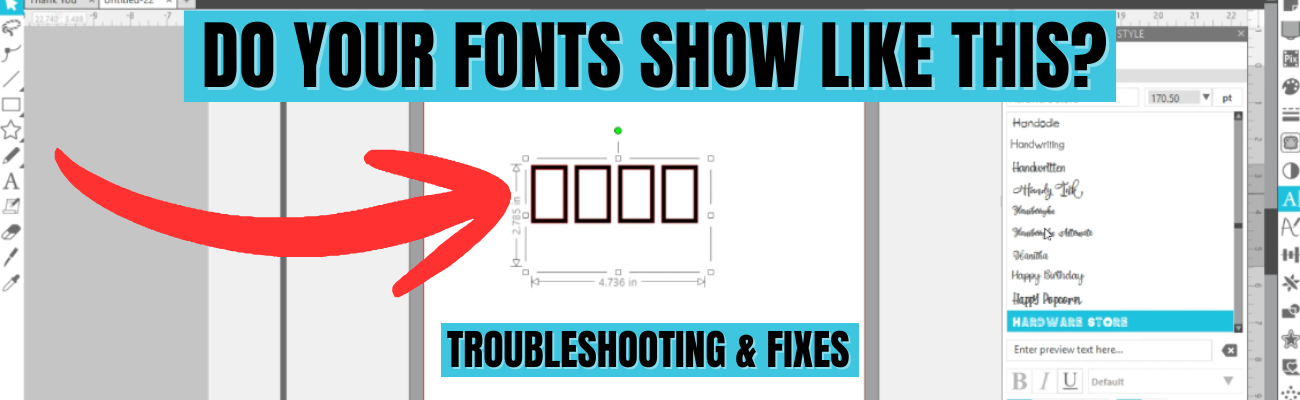
Have you ever opened Silhouette Studio, started designing with text, and instead of a beautiful font you’re greeted with rectangles, boxes, or missing letters? Font issues in Silhouette Studio are a common frustrations that we see when troubleshooting with users—whether fonts don’t show up at all, won’t display correctly, or refuse to work the way you expect. The good news? These problems usually have simple explanations and easy fixes once you know what to look for.
Affiliate links may be present in the following blog post and as an Amazon Associate, I earn from qualifying purchases.
Watch the video below or the Silhouette Secrets+ YouTube channel and it walks you through exactly why font issues happen in Silhouette Studio and how to troubleshoot them. In this tutorial, you’ll learn why fonts show up as rectangles, a glimpse at previewing fonts, why fonts can go missing or seem like they are missing, and how to reinstall fonts correctly—including whether OTF or TTF files work best. If you’ve ever wondered “Why is my font doing that?” this video will help you get back to designing quickly and show how to avoid some of these issues.
If you’re ready to go beyond troubleshooting and really learn how to use fonts to create your own designs in Silhouette Studio, come join us in the Creative Community with EllyMae | Crafting & Troubleshooting site. Our February 2026 exclusive member video covers working with text, fonts, and design techniques so you can move from simply typing words to confidently creating custom designs with fonts. It’s the perfect next step if you want to unlock the creative power of text in Silhouette Studio and design projects that are truly your own. In the 96 minutes step-by-step video tutorial I cover everything from where fonts are stored, font storage, designing with glyphs, offsets, compound paths, combining shapes, and more! Create 10 unique designs in less than 2 hours and then take and use those techniques to create even more!
Save this for future reference by pinning the image below.
Enjoy !
THANK YOU for your support! How can you help? Click HERE & buy a coffee. Every little bit helps with the cost of running the site.
Silhouette Classes
Never stop learning! Let me help you take the anxiety out of learning with Silhouette and get to creating faster! My Silhouette classes are heavily focused on software, so you can take the skills & techniques taught and apply them to many future projects!
**This post may contain affiliate links. What that means is that I may receive compensation if you purchase through the links I have provided. The price you pay for the product or service is not higher but I may get compensated for sharing.
Have you ever seen the message stating materials not found when opening a design in Silhouette Studio? Encountering the “Materials Not Found” message in Silhouette Studio can leave you wondering “What is wrong?”. Whether you’re working on a vinyl project, heat transfer design, or a print and cut masterpiece, this error can be frustrating and confusing. But don’t worry! In this post, we’ll explain why it happens and what to do next.
Affiliate links may be present in the following blog post and as an Amazon Associate, I earn from qualifying purchases.
Materials Not Found Message– Silhouette Studio
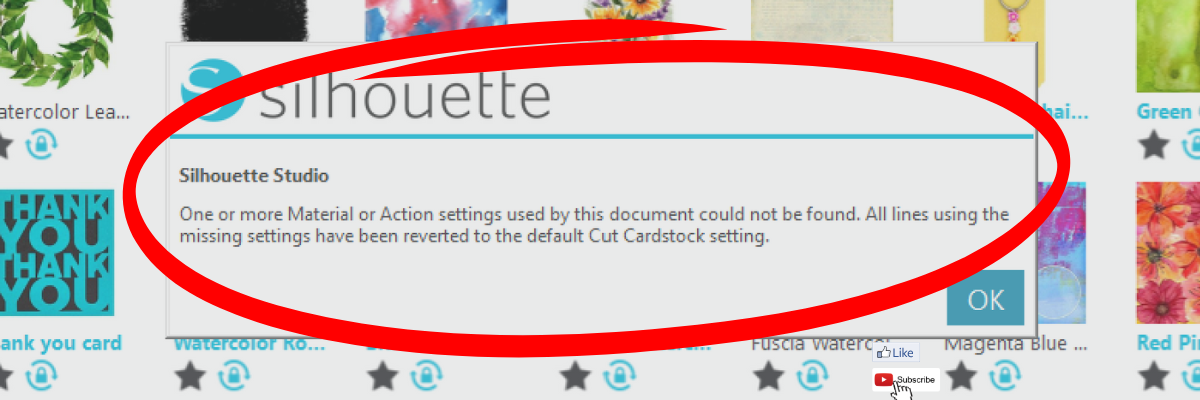
This is what the materials not found message can look like in Silhouette Studio on the Design Tab.
It can also appear when you are opening from the library tab before the image is placed on the design mat.
This materials not found message is not something to be alarmed about. It simply means that the cut setting that the person who created the file had on their software is not found within the Silhouette Studio software on your computer. This could be for several reasons.
The most common reason is that the designer has their own custom setting created and when they saved the design, those cut settings were saved with the file. When opened, if that cut setting is not on your Silhouette Studio software, it triggers this message.
Whether cut settings are saved with a file in Silhouette Studio is dependent on the software version that the design is saved with.
Another reason is that Silhouette has made changes to the cut settings menu and changed names or added/removed cut settings. With the release of newer model Silhouette machines, more cut settings have been added over time to the Silhouette preset menu.
This message is just letting you know that the cut setting has been switched back to the default of Cardstock. Click OK and proceed as usual.
When it comes time you cut the design, select the material that best fits your project and test cut.
While the idea of having a cut setting that works for all users perfectly is appealing, that is not reality. Materials vary worldwide and many factors go into getting a clean cut such as blade life, machine model, cutting mat adhesion, etc.
Here is a quick video clip demonstrating the ‘Materials Not Found’ message that appears when opening a design file in Silhouette Studio.
Save this for future reference by pinning the image below.
Enjoy !
THANK YOU for your support! How can you help? Click HERE & buy a coffee. Every little bit helps with the cost of running the site.
Silhouette Classes
Never stop learning! Let me help you take the anxiety out of learning with Silhouette and get to creating faster! My Silhouette classes are heavily focused on software, so you can take the skills & techniques taught and apply them to many future projects!
**This post may contain affiliate links. What that means is that I may receive compensation if you purchase through the links I have provided. The price you pay for the product or service is not higher but I may get compensated for sharing.
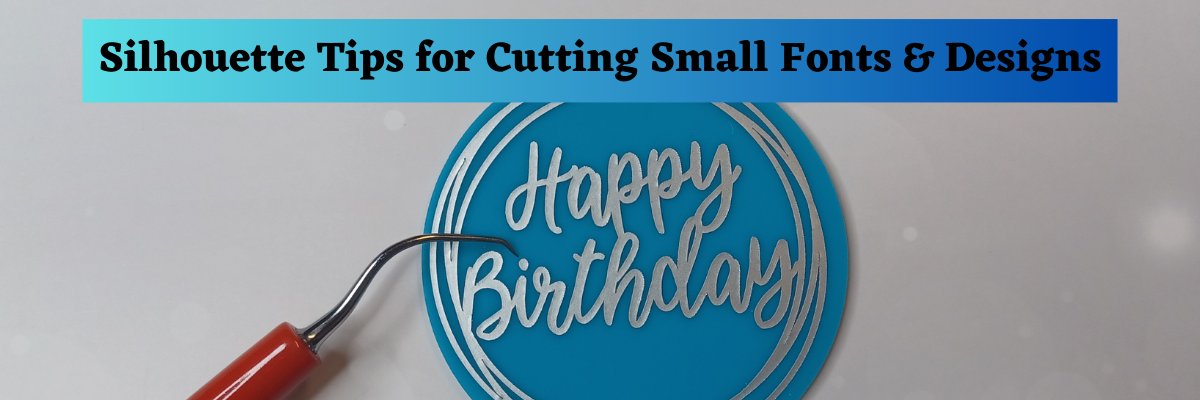
Cutting small fonts and intricate designs with your Silhouette can be a game-changer for creating professional-looking projects, but it also comes with unique challenges. From selecting the right materials to fine-tuning your machine settings, every detail matters when working with tiny text or delicate patterns. In this ultimate guide, we’ll share proven tips, tricks, and techniques to help you achieve clean, precise cuts every time. Whether you’re crafting personalized gifts, labels, or detailed decorations, these strategies will take your Silhouette skills to the next level. Keep reading to unlock the secrets to cutting small fonts and detailed designs like a pro!
Affiliate links may be present in the following blog post and as an Amazon Associate, I earn from qualifying purchases.
Have you ever tried to cut something small and it just did NOT work? You may have ended up with a mess of whatever material you were cutting. Well, you are not alone! It happens and I have some tips to help!
Silhouette “Secrets” – Tips to Cutting Small Fonts & Designs
Tip #1 – Font Style Matters
Not all font styles are good for cutting small.
An example is distressed fonts – all of those little bits and areas that show up in red will need to be cut. When you make it smaller, it just makes those areas smaller too!
Look at the Edit Points of a design/font. Fonts may need to be ungrouped in order for edit points to show up.
Make a copy of your original text before ungrouping to look at edit points.
Edit points are the data points that the machine uses to cut the file.
Right click Ungroup the text. Double click on the text selected and the Edit Points = gray dots show up. All of those dots are what the machine uses to complete the cut. It has to connect the dots.
If you scale the design down, it does not decrease the number of edit points, it just squishes them into a smaller space. Which can make cutting small or intricate designs even more difficult as the blade is moving to connect those dots in a smaller location.
When the Edit Points are activated, it should open the Edit Points Panel. If not, click on the Edit Points Panel on the left side tool bar.
Simplifying the Edit Points can help to make it cut smoother.
However, you want to compare the original to the simplified version and see if there is any noticeable change in the design itself.
Make a copy of the text before simplifying and then compare the before and after.
Click off of it to deselect it and compare the designs without the edit points active.
Did it change it enough? Did it change it too much?
Some designs/fonts you will see a drastic change and others you may not notice it at all, but it will help in cutting quality.
Here is another example – Giraffe Zentangle Mandala by Wispy Willow Designs is an awesome design. If you have ever worked with a zentangle style design before, you know they can be intricate. This design opens at 12″ tall and here is a look at the edit points that make up this design. They are a necessary part of the design due to the detail of it.
If you scale that design down to 3″ tall, all of those edit points are then squished together.
This is not a design that will not cut well at a small scale. That’s just not how it was designed because of it’s intricate detail. Zentangles are detailed and intricate designs.
In this case, simplifying the edit points probably still won’t yield good results. It was not designed to be cut small, but is amazing at a large size.
Want to learn even more about Edit Points? Check out this tutorial HERE.
Tip #3 – Use a Sharp blade
A sharp blade is going to cut much cleaner than a dull blade.
Having extra blades and cutting mats on hand will save you time, frustration, and money in the long run.
Keep separate blades for different materials. Just like having separate fabric and paper scissors! Different materials dull the blade at a different rate. This can also increase the lifespan on your blades.
Do not try to sharpen the blade. It is a myth that stabbing tin foil sharpens a blade. Metal cutting metal or stabbing metal does not sharpen a blade. That is like cutting a soda can with a kitchen knife, it only dulls it farther. If it does anything at all, it may clean adhesive off the blade or in a lot of cases we see, it can break the tip of your blade off and you end up with more troubles than you started with.
A brand-new blade is a great thing!
I always recommend having extra blades and cutting mats on hand! Grab some extras at CrafterCuts and use my code SECRETS to save 10% HERE. Free shipping with orders of $35 or more at CrafterCuts! Or grab some extras from Silhouette America HERE and use code SECRETS to save 5%.
Tip #4 – Test Cut, Test Cut, Test Cut!!!
When cutting small fonts, use that font as your test cut.
Type out a capital B to use as your test cut. It has straight lines, corners, and curves and you can see how it will be cut.
Using high quality products can make all the difference! Having issues, try a new brand or a new piece.
Vinyl does have a shelf life and it can depend on how it’s stored. I’ve had some vinyl that I’ve used 7 years later, but others that didn’t last 3 years.
Usually, the way I know it’s no longer good is it is very difficult to release from the backing and I am having to work harder at it than I should.
Small dots or periods are famous for getting lost. Simply make copies and cut a line of dots to add to your project as needed.
If one letter gets messed up, simply re-cut one letter to add to the project. No need to recut the entire design.
Discover even more with the step-by-step class on the Silhouette Secrets+ Teachable site, where I guide you through creating the designs featured above. Check out the Easily Create Custom Gift Tags & Keepsake Ornaments in Silhouette class to bring your creativity to life! View all of the classes available HERE.
Tip #8 – Reverse Weeding
After cutting, weed the large areas
Then place the transfer tape onto the entire design.
Weed it from the transfer tape.
Now, this method takes practice. I hated it the first time I tried it because I did not like that the transfer tape stuck to my hand while weeding. However, it has come in handy with some projects I’ve done and that was the only way I could get it to transfer properly.
I hope those tips help you be successful with future cuts when working with small details and fonts!
Save this for future reference by pinning the image below.
Enjoy !
THANK YOU for your support! How can you help? Click HERE & buy a coffee. Every little bit helps with the cost of running the site.
Silhouette Classes
Never stop learning! Let me help you take the anxiety out of learning with Silhouette and get to creating faster! My Silhouette classes are heavily focused on software, so you can take the skills & techniques taught and apply them to many future projects!
**This post may contain affiliate links. What that means is that I may receive compensation if you purchase through the links I have provided. The price you pay for the product or service is not higher but I may get compensated for sharing.
I hope these tips help! For more on Print and Cut check out the header on the blog HERE.
Save this for future reference by pinning the image below.
Enjoy !
THANK YOU for your support! How can you help? Click HERE & buy a coffee. Every little bit helps with the cost of running the site.
Looking for more in-depth, step-by-step classes, check out all of my online Silhouette classes on my Teachable site HERE.
**This post may contain affiliate links. What that means is that I may receive compensation if you purchase through the links I have provided. The price you pay for the product
Make sure to Like, Subscribe, and click the bell for future notifications when a new video is available on the YouTube channel too!
Save this for future reference by pinning the image below.
Hope these tips help to save you some frustration down the road!
THANK YOU for your support! How can you help? Click HERE & buy a coffee. Every little bit helps with the cost of running the site.
Looking for more in-depth, step-by-step classes, check out all of my online Silhouette classes on my Teachable site HERE.
**This post may contain affiliate links. What that means is that I may receive compensation if you purchase through the links I have provided. The price you pay for the product or service is not higher but I may get compensated for sharing.
We troubleshoot thousands of issues each week on social media and one of the questions we see often is about Library issues.
Most times it is a simple fix if the steps are followed properly.
One of the common ones we see is when a user’s library is showing as “Working Offline” in the bottom left corner. I find this happens if my internet connection changes such as when I’m traveling or the internet connection is dropped.
Check out that tutorial HERE. It still solves 98%+ of the library issues.
However, there are times that the above does not work, so I thought I’d share where you can find more information about specific library issues.
Silhouette America has recently updated their Support FAQ area and it is a bit more search friendly to find information you might need. Check out this post HERE on the Updates to the Silhouette America website.
Backup User Designs!!!!
As a note, it is ALWAYS recommended that you have any of your user designs backed up to an outside source. I do not recommend using the Silhouette library as your file storage as it is not designed as an all inclusive storage area but as a syncing device. This is one reason that the library is limited on storage space.
If you are using a Silhouette Studio version of v4.4.552 or higher, you can easily export individual user created designs as individual files and I HIGHLY recommend that you do this – right now if you have not already done it!
I want to share more information that can easily be found on the new Silhouette Support site. If you are experiencing any of these issues below, click on the title to be taken to step-by-step tips to help get you back on track.
Design Thumbnail Partially Missing Note: at the time of this publication, I am not recommending v4.5.152 – if you choose to update to fix this issue, I would recommend updating to Beta v4.5.171 – however, please note that Beta versions can have unknown bugs. But, I still would recommend it over the bugs that are in v4.5.152.
Silhouette Support has changed over the years since I started as an TJC Licensed Silhouette Instructor. At the time of this publication, they have not had phone support in 4-5 years. I can agree with this 100% as troubleshooting by telephone is very, very difficult – if not impossible in most situations. You cannot provide photos or videos of the issue you are having and the Support staff cannot provide a list of instructions that will help to solve the problem.
Currently, the only way to get in touch with Silhouette Support is through the online Support request found HERE or in the bottom right corner of the Silhouette America website.
Most issues that a user has could be solved by a quick search of the Silhouette America Support Solutions center and following the instructions exactly like they are written.
However, there are some cases where a Support tech is needed to address an issue. In that case, you will need to fill out all of the questions regarding the support request. And then make sure you complete it & that it gets fully submitted to them.
When you submit a request to Support, the best thing you can do is provide as detailed of a description as possible, photos of the issues, and/or video of the issue if necessary. This can help you get a diagnosis faster in most cases.
A support ticket that states “My machine won’t cut, fix it!”, really does not help you get an answer faster or help the Support Staff diagnose what issue you are having. It’s like throwing mud against the wall to see what sticks.
After you have submitted the issue to them, you will need to be patient and wait. The emails are answered in the order they are received in and you are in a line. There are other users with an issue that are ahead of you in that line and you don’t get to skip to the front because you feel your issue is more important.
Again, the more details you can provide when you submit your issue, the better chance you have of getting a diagnosis faster.
On that note, if you are having cut issues, follow this Troubleshooting Video HERE step-by-step and it fixes 98%+ of the cutting issues that we see.
We troubleshoot thousands of issues weekly across social media platforms and in most cases ask for photos and/or videos in order to diagnose the issue. You would probably be amazed at how many times we spot something in the photo or video that we weren’t even looking for that is culprit of a cut or software issue. Without seeing the photo or video, we would have never diagnosed it and the user would have continued to be frustrated.
When we ask for a photo of the blade installed in the machine with the mat loaded, it is NOT just to look at the blade installation. There are MANY things we can tell from this photo that can help in identifying the problem. Most times it’s a quick fix. Otherwise it can be like throwing mud against a wall to see what sticks….. And sometimes it’s not specifically what we are looking for but what doesn’t look right – for instance, an adjustment hole blocked or vinyl stuck to the bottom of the blade.
A photo is really worth a thousand words.
Here are just a few things I can identify from a photo: – blade housing alignment – is the cutting mat covering adjustment holes – adjustment holes have debris – adhesive build up on rollers – debris stuck in the machine – what machine model it is – what blade is being used – is the cutting mat loaded sideways And yes, if the blade is installed and locked in.
Those are just a few…. it would amaze you the little things we have picked up on that are the cause of a cut issue just from a photo. And until the underlying issue is identified and resolved, a user will continue to experience cut issues.
Silhouette “Secrets”
This blog post originally started as just troubleshooting for the Silhouette library and issues you may have. However, I couldn’t just stop there.
What is my “secret” to troubleshooting?
1 – Experience! On my recent trip to Italy with Siser, our tour guide in Venice said she would get so many people questioning how she knew something. She said it took her awhile but she finally came up with an answer. EXPERIENCE!
The more you do this, the more you watch your machine, the more familiar you become with the Silhouette software and the Silhouette machines, you will start to see how things work. Or be able to spot when something is “off” and then upon closer examination can figure out what is the cause.
I have been teaching Silhouette users since 2016 and I troubleshoot daily. I see a lot! I also watch my machines work and I listen to them! Yes, they will talk to you or at least you can hear when they yell at you when something might be wrong.
2 – I have no “secret”. I treat each case I troubleshoot as a new issue because there is no one button fix for all issues. No matter the experience level of the user, I follow the same steps in troubleshooting. To be honest, for experienced users it’s often harder to troubleshooting with them because they are not always as willing to following instructions or provide us the information needed to help them.
Tip: When asked to provide information, photos, or video – the faster you do it, the faster you are going to get help and fix any issue you are having. Help us, help you!
I hope these tips help you on your Silhouette journey!
And I have a coupon code to save 10% on your order Use code SECRETS at CrafterCuts Get free shipping with a $35 order I always recommend having extra blades and mats on hand for your projects!
We love seeing what you are creating with your Silhouette machines or software. Feel free to post photos or questions on my Facebook group at Silhouette Secrets with EllyMae.
Save this for future reference by pinning the image below.
Enjoy !
THANK YOU for your support! How can you help? Click HERE & buy a coffee. Every little bit helps with the cost of running the site.
Or if you are looking for more in-depth, step-by-step classes, check out all of my online Silhouette classes on my Teachable site HERE.
**This post may contain affiliate links. What that means is that I may receive compensation if you purchase through the links I have provided. The price you pay for the product or service is not higher but I may get compensated for sharing.
The CAMEO Pro was released almost 2 years ago. I am one of the original testers of the CAMEO Pro before it was released and have hundreds of cut hours into this machine. Since the release of the CAMEO Pro, we have troubleshot thousands of user’s cut issues.
Today I am releasing 2 new series for troubleshooting the CAMEO Pro.
The first series is a 5 part series that is on my Silhouette Secrets+ YouTube channel and it’s meant to be a quick view of the top 5 issues we have seen for cutting issues with the CAMEO Pro.
The second series is an in-depth look at the CAMEO Pro on my Teachable site.
Become a PRO at Troubleshooting Your CAMEO Pro
I want you to be the most successful you can be using your CAMEO Pro!
There are a lot of variable that can be the source of a cutting issue on the CAMEO Pro or any model Silhouette machine. If you do not find the exact issue that is causing the cut issue, you will most likely continue to experience inconsistent cuts until that is found.
Join me as we take an in-depth look at the CAMEO Pro!
This course is an in-depth look at the CAMEO Pro! I held nothing back. I’ll be honest, some of you won’t make it through. Some of you will give up! But those of you who make it completely through the YouTube series and this Teachable course WILL be Pros at your Silhouette CAMEO Pro AND You will be able to troubleshoot 99% of the issues you have with this machine!
I want you to be successful with your CAMEO Pro!
I would highly recommend that you watch both all the way through, especially if you are a new user or if you are having cutting issues!
You can be a PRO at troubleshooting on the Cameo Pro and save yourself time & frustration!
Most times in our troubleshooting we find that it is just a few small things that need to be adjusted for a user to correct a cut or feed issues.
I would love to see what you are creating with your Silhouette software or machines! Feel free to post on my Facebook group at Silhouette Secrets with EllyMae.
Save this for future reference by pinning the image below.
Enjoy !
THANK YOU for your support! How can you help? Click HERE & buy a coffee. Every little bit helps with the cost of running the site.
Or if you are looking for more in-depth, step-by-step classes, check out all of my online Silhouette classes on my Teachable site HERE.
**This post may contain affiliate links. What that means is that I may receive compensation if you purchase through the links I have provided. The price you pay for the product or service is not higher but I may get compensated for sharing.
THANK YOU for your support! How can you help? Click the link to buy a coffee. Every little bit helps in the cost of running the site.