Posted on 16 Comments

Let’s Explore – The Curio – Getting started

There is this little Silhouette machine called the Silhouette Curio that came into my studio and has quickly grown to be another favorite tool.

IMG_8837 copy

Now, I have to admit that the first day I opened the box, I did holler upstairs to my husband and say something like “I think I made a mistake. I don’t get this machine.”
But, at that point and time there was not much out there to tell you how to get started with it.
Now, the more I use it, the more I love it!!!

So I thought I’d share a few tips to get you started with it.

Silhouette Secrets+ – Curio tips

Platforms

The Curio differs from the Cameo in that it uses a platform system to accommodate thicker materials. The Curio has a clearance of 5 mm and the platforms are added or taken away from the base to bring the height up or down as needed.

This machine comes with a 8.5 in. x 6 in. base and platforms labeled 2, 2, 1, 1 = cutting mat, and 1 = embossing mat.

IMG_8838 copy

The platforms are stacked on the base for a total number of 6 to reach the height for the machine to work.
Each material that is used will vary in the number of platforms needed to use with the machine.

For instance, if you have a thin material under 1 mm, you would use a total platform stack of 6. This would be for materials such as cardstock, adhesive vinyl, heat transfer vinyl, or the Silhouette metal etching sheets. These are thin materials and need all the platforms in to reach the height needed to perform the task.

What I can tell you from lots of testing is that each material you get will be different and testing is the very best answer.

For example, I get my acrylic for etching from Craft Chameleon and it is 3 mm thick. I get a good etch using a platform stack of 2+1+the cutting mat and the Silhouette etching tool. If you add this up, it equals a total of 7. Yes, that is more than 6, but my etch comes out well.

Silhouette-Secrets.com_etchedpanel

Every material and brand of material will vary in what works best. Testing is the answer.

Curio must be recognized by the software

With the Silhouette software open, plug the Curio in to the computer and turn it on.

IMG_8844 copy

Next, click on the Send tab in the top right corner.

Send tab copy.jpg

Then gently load the base in the Curio machine and push the Load button. When the base is loaded you should get a message that a new machine has been plugged in and the Emboss Panel will then be unlocked for you.

You will see at the bottom of the Send tab that the Curio now shows Ready instead of Syncing.

Curio ready copy.jpg

With the v4.2 software version, the Emboss Panel will not unlock the first time a Curio is plugged in until you have loaded the base in the machine. This is how it recognizes that a new Curio has been plugged in.

Curio base position

The Curio machine is unique in a way that the machine can be paused and unloaded in the middle of a project and then be reloaded and continue in the exact place it left off. This is if the Curio base is loaded into the machine correctly.

There is a notch on the side of the Curio base.

IMG_8842 copy

This notch must be loaded into the machine past the front of the machine in order to orient the blade into the correct starting position.

IMG_8843 copy

How far past the front? There is no magic area, just past the front of the machine. I always push mine in so it is well inside the machine before pushing the Load button on the side.

Emboss Panel

Once the Curio is recognized, the Emboss Panel in the software is unlocked. This allows you to fill designs with different patterns and fills.

Emboss panel copy

The Emboss panel is where I do most of the designing for etching. Each user will vary in what they like to use as an emboss fill. I prefer a tight etch and often use the Cross hatched fill with a small spacing. Check out this post on the Emboss Panel for a detailed explanation of the entire panel.

Test the materials and have fun!

There are so many options in creating with this machine and you will learn so much from just playing with it.

Here are a few projects I’ve created with the Silhouette Curio.

SilhouetteSecrets+_acryliccoaster

These acrylic coasters are from Craft Chameleon and etched with the Silhouette Etching tool. The Silhouette Etching tool is not typically in the original Curio purchase, unless it is a special bundle. So you will need to order that separately.

SilhouetteSecrets+_leathertooling

Above is a leather bracelet that I designed and tooled with several tools in the Silhouette Curio. The Curio did not cut clean through the tooling leather, but it cut most of the way through and then I could use scissors to cut the rest.

SilhouetteSecrets+_metaetching

This is a Silhouette metal etching sheet and what I recommend for a beginner to start etching with and practice. I would suggest creating smaller designs and using the entire sheet to practice. It is double sided too, so more bang for your buck!

Check out this virtual demo table on my Youtube channel of many Curio projects I’ve done HERE.

Need a little more help getting started with the Curio?
These classes and tutorials may help:
Beginner Setup & First Cuts on Cardstock & Vinyl online class HERE
Beginner Metal Etching tutorial HERE
Basic Acrylic Etching online class HERE

Don’t have a Curio yet, but are in the market? Here are 3 places to shop for one:
Silhouette America
Swing Design
Amazon

Save this for future reference by pinning the image below.

I would love to see what you create – feel free to post on my Facebook group at
Silhouette Secrets+ with EllyMae.

Enjoy!

SS Logo snip it

**This post may contain affiliate links. What that means is that I may receive compensation if you purchase through the links I have provided. The price you pay for the product or service is not higher but I may get compensated for sharing.

Posted on 21 Comments

Print and Cut – Part 1

Let’s Explore v4 – Print & Cut – Part 1

I love the print and cut option on the Silhouette software!

I’ve used it for many years and in this 2 part series I will share some tips with you for getting a successful print and cut.

A few weeks back I made up special Chemo day gift bags for a friend of mine who is a Planner gal. I found a few print and cut files that I knew she would like on the Silhouette Design Store and then set up to print them all out in the Silhouette software, then I let the Cameo machine do it’s work and cut out around them. I will say that every single one turned out perfectly!

silhouettesecrets_pnc copy

I was asked so many questions, I thought I’d show you how I did it. I am going to break this up into 3 parts so you get the most out of it.
Part 1 – Setting up a pre-designed Print and Cut project
Part 2 – Print and Cut – Text
Part 3 – Print and Cut – Images

Pre-Designed Print and Cut Project

First, find a Print and Cut design that you like. I am using the ML Panda Love Stickers from the Silhouette Design Store (this file is no longer available in the store).
This can be used for any print and cut file available – click HERE to see more Print & Cut designs.
Search by file type and narrow the search down in the Filter on the left side.
For instance, in the photo below, I searched Print & Cut Design Type & Planner for the keyword.

Planner Sticker image

Open it in the Silhouette software.
Every file you open will be different in what it looks like when you open it and is based off how the Designer saved it.

open file

Next, on the Page Setup Panel, adjust the Page Size to Current Printer. Also, check the boxes next to the Show Print Border and Show Cut Border. These are guides that will help in lining things up so they print on the page and are not outside of the cut area.
With the Reveal set at 0% you will see a white page that is the size of the Page Size you have chosen.

page size copy

Now, in order for the Cameo to read where the design is on the printed page, we need to add Registration marks. Click on the Page Setup Panel – 3rd tab – Registration Marks.

registration marks panel copy

Then choose Type 1 Registration marks if you have a Cameo, Portrait or Curio.
If you have an older model machine before the Cameo 1, then you would use the Type 2 marks.

You will notice 3 marks appear on the Page. A square in the top left corner, a corner bracket in the top right corner and bottom left corner (this is with the Portrait Orientation – Page Setup chosen – this is the Orientation I recommend).

registration marks copy

Tip for a beginner or for print and cut issues.

  • Click on the Restore Defaults button. This will reset the Registration marks to the default and this is where I suggest you start from.
    While the registration marks can be moved, each printer will vary in how far they can be moved and still get an accurate cut. I suggest starting with the default registration marks and then you can test from there once you are familiar with the print and cut process.

Next, make sure that your Print and Cut design is inside of the Cut border. Notice that the Cut border has now moved in line with the 3 registration marks. Anything outside of that border will not cut and may interfere with the reading of the registration marks.

cut border copy

In the photo above, I need to move the design to the left because it is too close to the right cut line.

And the design cannot be in the cross hatched area of the print and cut. The optical eye of the Cameo needs this area to read those registration marks correctly. If the design is in the cross hatched areas, it can interfere with the optical eye reading and either give you an error or an inaccurate cut.

The cross hatched areas are across the top and the bottom left corner.

print and cut parts

As I mentioned above, each file you open will be different. With this file, there are 2 parts to the print and cut design. One part is the graphic of the pandas and the second is the cut lines. If the design needs to be moved, make sure to select & move both parts together.

print and cut to send

Once my design is moved away from the cut border and the cross hatched areas, it is ready to send to the printer.

There are 2 ways to do this.

Click on the Printer icon in the top left corner. This will send the print job directly to the printer that is set as the default printer connected to your computer.

Printer icon copy

In the top left corner, choose File > Print and you will get a pop up of Printer options. (Ctrl + P)

file print
The options vary by the printer you have connected to your computer.

Tip: If you have a Preferences button, click on that and look for a “Preview before Printing” option. This is a great feature to see if it is going to print how you want it to before actually committing to the print job.

print preferences copy

Check the Preview before Printing box.

preview before printing copy

Then click OK.

print copy

And choose Print.

A Printer menu will pop up and the design can be previewed before committing to printing.

print preview
Again, this will be dependent on the printer and what the printer setup settings are. Not every user will have this and it can vary, but never hurts to look for it.

Tip: Check to make sure that the bottom left registration mark will print completely. I see a lot of print and cut issues and one is the registration marks were outside the users printer margins and did not print. This means you will either get a registration error or it will cut inaccurately because it doesn’t have all the information to read it correctly.

Once you’ve verified the settings are correct, click on Print and it will send it to the current default printer.

silhouettesecrets_pnc_printer

Grab it off the printer.

Place it on the Silhouette cutting mat exactly as it shows on the virtual design screen, in the top left corner of the cutting mat.

silhouettesecrets_printed

Then load the cutting mat next to the line on the left that the arrows point to.

silhouettesecrets_arrow copy

Click on the Send tab in the top right corner of the Silhouette software.

send tab top right copy

Choose the Material type.
I am using the Staples brand Sticker Paper and the preset for Sticker Paper – White works well for me.

send tab copy

Tip: If cutting a new material, use the test cut feature to test that material before you send the entire project. This can save you lots of headache on mis-cuts.

Once you click on the Send button on the bottom of the screen, the Cameo will then read the registration marks and begin the cut.

silhouettesecrets_sticker2

Perfect print and cut!

Save this to Pinterest for future reference

Print & Cut 1

Troubleshooting Print and Cut

Did it not cut accurately or did you get a registration error? Here are a few things to check when you do run into an issue.

  1. Do you have the correct registration marks chosen? Type 1 should be used for the Cameo, Portrait or Curio machines.
  2. Did the registration marks print on the page? Make sure on the Page Setup Panel – 3rd tab – Registration marks that they are turned on.
  3. Did the registration marks print completely? I often see the bottom left registration mark did not print completely because it was outside of the printer margins. Check to make sure it printed completely and if not, then either move the registration mark slightly up or increase the Printer margins under the Printer Setup.
  4. Is the design in the cross-hatched areas of the print and cut? This will interfere with the optical eye and can either result in a registration error or inaccurate cut around the design. Move the design away from the cross hatched area and reprint on copy paper until you get an accurate cut.
  5. Did the registration marks get moved? Each printer will vary in how far out the registration marks can be moved and still read accurately. Click the Restore to Defaults and use those as a test to get an accurate cut. As you become more familiar with the process and your printer capabilities, you can move them out and test how far the limit is.
  6. Were changes made to the file after the design was printed? This will result in inaccurate cuts because the design is no longer in the same place it was when it was printed. Re-print and do not move the design after printing.
  7. Did the printer feed multiple pages through at a time? Or did you print more than one copy at a time? For best results, I suggest feeding one sheet of material in the printer at a time. Multiple copies printed can result in the paper being pulled in too quickly and then the print is off on the page and not accurate.
  8. Is the printer low on ink? Ink quality can interfere with the optical eye reading the registration marks accurately.
  9. Was it printed at high quality? Printing at a low quality can also affect how the optical eye reads the registration marks.
  10. Still getting a registration error? Start over on a new design mat and go through each step again. Then print a test print on copy paper.

I hope these tips help you have a successful print and cut experience.

Pin this image to Pinterest to save for future reference

Troubleshooting PNC

Want to know more on Print and Cut?
Check out Part 2 – Print and Cut – Text & Part 3 – Print and Cut – Images

I would love to see what you create – feel free to post on my Facebook group at
Silhouette Secrets+ with EllyMae.

Enjoy!

SS_Signature copySS Logo snip it

**This post may contain affiliate links. What that means is that I may receive compensation if you purchase through the links I have provided. The price you pay for the product or service is not higher but I may get compensated for sharing.
Posted on 16 Comments

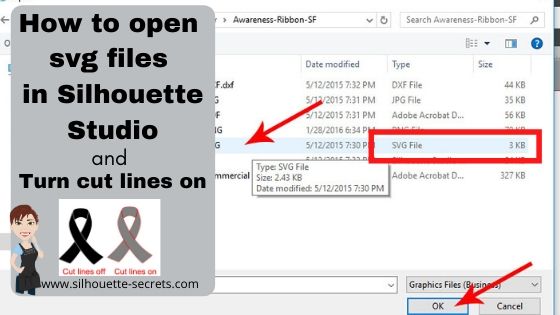
Let’s Explore v4 – How to open an svg file

I see many questions regarding .svg files come up across the Silhouette world, so let’s take a look at it.

What is a svg file?

A .svg is a Scalable Vector Graphic.
But what does that mean to a Silhouette user?
It is a cut file that you can resize without losing image quality.

How is it different than a file from the Silhouette Design Store?

Silhouette design store files (.studio or .studio3) files are a proprietary file that can be found in the Design store and downloaded direct to your Silhouette library. These files should be ready to cut when you open them.
These are the easiest files to open and cut as a new beginner with the Silhouette and what I would recommend a new user starts with.
As with any file, it is dependent on how the designer saved the file.
The Silhouette Design store does have an option to purchase the .svg file in addition to the .studio file, however, it is not needed unless you are using it outside of the Silhouette software.

An .svg file is a common cut file and can be opened in many programs.

How to Open a .svg file in Silhouette Studio

In order to open a .svg file in the Silhouette Studio software it requires a Silhouette software upgrade of Designer Edition or higher. I highly suggest at least the Designer Edition upgrade, it is a great investment and will save you time & headache in workarounds.

With a software upgrade to Designer Edition or higher, it unlocks additional features in the software.
For a list of those features unlocked with each upgrade check out this chart from Silhouette America HERE.
Click on the video camera icon for a brief demo of each feature.

Where do you find the software upgrades?

The software upgrades can be found at an authorized Silhouette retailer. I suggest Swing Design or Silhouette America.

After you purchase the upgrade and receive the code, enter it under Help > Upgrade in the software and it will be active.
As you can see in this photo, my Upgrade option is grayed out because I have the highest level of Business Edition. This will show at the top of the software or under Help > About Silhouette (PC) or About Silhouette (MAC).

upgrade

Extracting a downloaded folder

The first step to opening a .svg is to download the file from the source. Most files will come in a zipped (compressed) folder and this will need to be unzipped/extracted first. This will depend on your computer system but for me on a Windows PC, I right click on the folder and choose Extract All. Or select the file by clicking on it once and choose the Extract button at the top of the folder.

Extract file copy.jpg

You can tell this is a compressed folder because it says at the top of the window and has a zipper on the file icon.

compressed folder icon copy

You will not be able to access the full design files unless the folder is unzipped/extracted.

Once you click the Extract All button, it will give you the options to choose where to save the Extracted file to. Select where and then click Extract.

extracting file copy

Now, the folder can be fully accessed.

Opening a .svg file in Silhouette Studio

Now that the downloaded file is fully accessible, it can be opened in Silhouette Studio. Again keep in mind, that you must have the Designer Edition upgrade or higher in order to open a .svg file in the Silhouette software.

As with a lot of the tools and features, there are several ways you can open files in the Silhouette software.

1. Using the menu options. 

In the top left corner, choose File and then Open.

file open

Then choose where the file is located and click OK. Or double click on the file and it should open in the Silhouette software.

file open location copy

2. Drag and drop the file from the Computer folder. 

With the Silhouette software open on the Design tab, open the My Computer folder where the file is saved.

drag and drop copy

Now grab the .svg file by left clicking the mouse and holding the mouse button down, then drag the file on to the design mat of the Silhouette software.

Drag and drop1.JPG

The design will show up on the Silhouette work space where you drag it to.

3. Double click the .svg file to open directly in the Silhouette software.

The computer will use the default program to open any file type when you double click it.
What does this mean?
You will most likely have to change the default program that the computer uses to open .svg files with a double click.

When an .svg file is downloaded, the icon shown next to the file name will most likely be a web browser icon such as Internet Explorer or other. This means that the computer is set to open a .svg file with a web browser. But, you can change that.

Changing the default program for .svg files on Windows

Right click on the .svg file name and choose Properties.

default program svg

Under the General Properties tab, next to the “Opens with” section, click on Change.

properties copy

Now, find the Silhouette program and choose it as the default. Scroll down to the bottom and choose More Apps if you do not see it in the list.

file type svg default

You may need to keep clicking to look further on the computer programs.

file type svg default2

Once you find the Silhouette Program keep on clicking into the folder, then choose Silhouette Studio for the default to open .svg files.

file type svg default3 copy

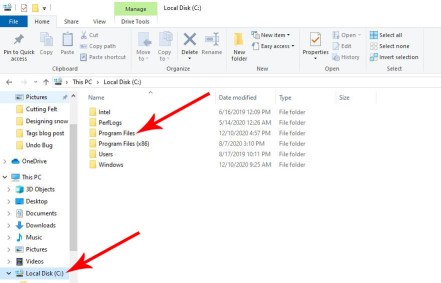
The Silhouette software will be found under the C: Program Data (x86) if you are using a software version older than v4.3.
For all v4.3 and higher versions, the software is found under C: Program Data.

Once you have set the default to use the Silhouette software to open a .svg file, then you will see the icon next to the file name change to the Silhouette icon.

silhouette default program copy

And when you double click on that file, it will then open up in the Silhouette software.

Silhouette default program1.JPG

Another tip here is that you can change how a .svg file opens in the Silhouette software. The choices are As Is, Centered, or Fit to Page. You will find these options under the Import tab in the Preferences.
I have mine set to open Centered, meaning that the .svg image will be centered on the design mat.

preferences copy

MAC users: On a Mac – right click on any SVG file, then click on Get Info. In the popup window, near the bottom, you’ll see where it says “Open With”. Click on that and you’ll see a list of programs. Click on “Other” to open the Applications folder, where you’ll be able to select your Silhouette program. If Silhouette Studio is greyed out, make sure you have “All Applications” enabled. There is also an option in the Get Info window to make the selected application (in this case, Silhouette Studio) open all file types with the same extension as the one selected (which would mean all SVGs in this example).
Thanks to my colleague Lycia Evanoff with Caught By Design for this MAC information.

Now, once the .svg file is open in the software there is one more thing you will need to do before it will cut.

Turn on the cut lines.

The .svg files open in the software with the cut lines defaulted to off.

How to turn the cut lines on. 

1 – Select the image by clicking on it.
You will know that it is selected by the gray box showing around the object.

Selection box copy.jpg

2 – In the top right corner of the Silhouette software, choose the Send tab.
You will notice that the design is selected and “No Cut” is highlighted on the right. This is because the default for a .svg file is the cut lines are off.

send tab copy

3 – Choose Cut and the bold red cut lines should turn on.

send tab cut lines copy

Two key things to note here are:

  1. The Design must be selected in order to turn the cut lines on. If nothing is selected, choosing the Cut option will not turn anything on.
  2. It must be the .svg file that you opened. Other file types such as .jpeg or .png files are not cut files and will not have cut lines around the object. Most often you will only see the outer edge of a jpeg or png file turn on and show a rectangle.jpeg or png copy

There are so many great cut files out there and from many locations. The file that I used as an example today is from SoFontsy that has 100% Commercial Use friendly designs.

Keep in mind that with any file you acquire, it is dependent on how the designer designed and saved it.

Hope that helps explain a very common question I see all the time.

Save this for future reference by pinning the image below.

Feel free to post your comments and questions below or on my Facebook group at Silhouette Secrets with EllyMae.

Enjoy!

SS Logo snip it

**This post may contain affiliate links. What that means is that I may receive compensation if you purchase through the links I have provided. The price you pay for the product or service is not higher but I may get compensated for sharing.

Posted on 22 Comments

Let’s Explore v4 – Silhouette Library tips

Silhouette Library Tips

*Blog post written with v4.1.206 of the Silhouette Studio Software

Happy New Year!
And what a better way to start the New Year off then getting our Silhouette libraries in shape.

In the Silhouette software, you will find the Library tab in the top right corner.

Library tab copy

Once you click on the Library tab, you will see the Library tree on the left side and the Design Preview Area on the right.

Silhouette Library copy

Silhouette Studio Library

As of this post (January 2, 2019), there are 2 main sections of the Silhouette library.
(This will be changing when v4.2 is released, so the information will be relevant for any user prior to v4.2.)

  1. Local User section – this is the top section of the library and is computer specific. This means that personal files stored in this location do not automatically transfer to another computer, sync up to cloud, or are stored in another location.Local User copy
    Under the Local User section, there are several default folders.- Recent Downloads – this is where the Free files that come with a Silhouette machine will download to after the machine is connected, the Send tab in the software is selected, and the Silhouette machine is recognized.- User Designs – this folder is where you can save your personal designs. Keep in mind that this section is computer specific.

    Under each folder, right click on it and a menu will pop up. This is how you can create new folders to organize the library tree.

    New Folder copy

  2. Cloud library – this is anything under the email address in the Silhouette library tree.Cloud library copy
    Under the Cloud library, there are also several default folders.- Fonts – fonts files from the Silhouette Design Store will show under this folder. You cannot access the font files from this but it does show you which ones you have from the Design Store.
    For information on how to install fonts from the Silhouette Design Store, check out this post by Julie Huggins at Sew Craft N’SpiredInstalling Fonts for Use in the Silhouette Software.- Library – this folder contains several more default folders and more folders can be added to organize the library.

    Recent Downloads – this appears under the Library folder. If you do not see it, click on the (+) sign to expand the folder out.

    Library recent downloads copy.jpg
    This is where the files from the Silhouette Design Store will sync up to after the checkout process is complete. All files from the Silhouette Design store will download to here and you can move them to organize once they are synced up.

    NEW!!! Silhouette America recently added the feature to be able to also download the Silhouette files directly to your computer.

    Store download
    This is a great feature for those who do not like using the Silhouette library.

    On any new purchases, you can choose the Download button at the end of the Checkout process as shown above.

    For older purchases, this can be accessed under the Silhouette Design Store > Account Settings.

    Account Settings copy

    Then you will either choose My Designs (single file download) or My Download History (download by Order #).

    Account Settings1 copy

    Note: if accessing the Silhouette Design Store through the Silhouette software, it does give you a warning that it will work better through a web browser directly.
    This message says
    “Direct downloads work better in a Web browser (i.e. Chrome, Internet Explorer, Safari) than the software’s browser. 
    You can download this order a the following address after signing into the store in your browser: ….”
    This is the method I prefer to browse the store in most often.

    Download designs.JPG

    My Designs

    Click on the individual design file and then you will see a Download button available.

    My Designs copy

    My Download History

    Click on the Order number and then you will see Download buttons.

    My Download History1 copy.jpg

    Here you can choose to Download all or select which files that you want to be included in the downloaded folder.

    My Download History2 copy.jpg
    Then click on the Download now button.

    My Download History3

    User Design – this is found under the Library folder as well. Save your personal files to this folder.

    Cloud library copy2

    Patterns – Pattern files from the Silhouette Design Store will download here or add your own.

    Recycle – delete and clear files from the Silhouette library.

    Now, while the Silhouette Cloud library does sync to multiple devices there are some things to be aware of.
    This is direct from the Silhouette website regarding the Silhouette Cloud library.
    “Silhouette America’s Cloud Storage is a syncing service rather than a backup service. Files deleted locally will be deleted on the cloud. We strongly recommend users save important and/or valuable files to another location outside of the cloud or local library, or to a third-party backup service.”

    Show All Designs
    At the top of the Library tree, you will see a folder that will give you the option to see all the designs in the entire library.

    All files copy

Whew! That is a lot of information on the Silhouette Cloud library.

But that’s not all.

Tips on the Silhouette Library

Shape up your Silhouette Library copy

Organize designs into folders.

Create a new folder by right clicking on a folder in the library and choosing “New Folder”. This will add a new folder under the current folder that was selected.
New Folder copy
Here is an example from my Library tree.
Library folders.JPG

To move designs from the Recent Downloads folder, click and drag the design icon from the Design Preview area and drag it into the folder where you want it.
Check out this video on how to move designs in the Silhouette Library.

Each user’s organization is going to vary depending on what files they have. My 2 largest folders are Christmas and Wine, at the moment I’m not sure which one is winning.

Use the Search option

At the top of the library, type in a keyword you would like to pull up. This can narrow down the designs you have to scroll through in the library.
Search copy

Back Up! Back Up! Back Up!

It is always a good time to make a backup and I recommend getting in the habit of doing so on a regular basis.
Here is how to make a backup of the library. Note, this will be 2 separate files.

Local User Section

Right click on the Local User section and choose Export. Save this file to a safe location. I like to save mine with the date included.

Export Library1 copy

Cloud (email address and below) Section

Right click on the email address, choose Export and save this to a safe location. I add the date and ‘Cloud’ to the name of this file, so I can tell the difference in the files.

Export Library copy

Store personal files outside the Silhouette library

I would highly suggest keeping at least a back up copy of the library on an outside source.
Personally, I keep a hard copy of all other files not from the Silhouette Design Store, on an external hard drive.
Each user will have a storage system that they most feel comfortable with.
For me, I have my main external hard drive and then I have a larger one that I backup to as well. Not as often as I should, but I’m working on that.
You could also use an online storage such as google drive, drop box, etc.
However, keep in mind that nothing is 100% safe and you never know when something can happen such as a computer crash.
Having multiple copies of your files backed up is always a good idea!

I hope this has helped you learn a little about the Silhouette library and give you some ideas for getting your library in shape.

Now, if you caught a glimpse of my library tree in the photos above, it’s time for me to do some organizing as well. With the recent Silhouette Design Store sale, I have some files to put into folders.

Library organization copy

Hope that helps you start the year off right by getting the Silhouette library into shape & making a backup!!

Feel free to post your comments and questions below or on my Facebook group at Silhouette Secrets with EllyMae.

Enjoy!

SS_Signature copySS Logo snip it

**This post may contain affiliate links. What that means is that I may receive compensation if you purchase through the links I have provided. The price you pay for the product or service is not higher but I may get compensated for sharing.


Posted on 3 Comments

Let’s Explore v4 – Tiling

The Tiling feature is a Business Edition upgrade feature that is found under the Media Setup Panel – Tab 4.

The Media Setup Panel is found on the right side of the Silhouette software at the bottom of the icon toolbar. Depending on the size of your computer monitor you may see all the icons or you may have an arrow for a fly out menu.

Tiling Panel double copy

Since the Cameo can only cut 12″ wide, the tiling feature can be used to break up a big design into smaller pieces to be placed together after the cut. While the knife feature could also be used, why not let the software work for you and break it up. This feature is available if you have the Business Edition upgrade of the software and is only accessible under the Media Layout Setup Panel and with the Media Layout View active.

In the Media Layout View, the original design stays intact and all changes take place on the side of the Media Layout View. Check out the post from last week on the Media Layout View here.

I am going to use this Scandinavian Snow Princesses by Erin Doran – Design #68466 from the Silhouette Design Store for my example.

Snow Princess design

First, I’m going to resize this so the silhouette is 5 feet tall. To do that, open the Transform Panel – Scale tab, lock the aspect ratio and change the Height to 60″.
For more information on the Transform Panel – Scale tab click HERE.

Resize copy

Now, I am only going to work with 1 of the princess designs at a time, so I’m going to right click and choose Ungroup and delete the princess on the right side.
In the case of this file, I ended up choosing Release Compound Path to separate the princesses. Then, I selected all the parts of each Princess, right clicked and chose Make Compound Path for each again.
Find out more about Compound Paths HERE.

If you plan to cut both, you can leave it as is or copy and paste the right side to a new design mat to use later.

Now, let’s look at the Tiling feature.

Tiling Panel detail copy

  1. Tiling Active – Check this box to activate the Tiling feature. The Media Layout View will adjust to show you the number of tiles (according to the Page Size set) that it will take to cut the design.Tiling ActiveYou will also see on the left side in the Design View, that it adds a grid over the design with dimensions of each tile, and numbers of tiles. It does not alter the design on the left side, but adds this visual as an overlay of how it would divide the design up.

    On the right side, in the Media Layout View, it shows each of the tiles in the order of the numbers shown on the left side.

    For this design to cut on a 12″ x 12″ mat, it would take 14 – 12″ x 12″ tiles.

  2. Configure Position and Size – Choose Relative to Job, Relative to Media or User Defined. Each of these options allows you to adjust the design even more.Relative to Job – This option is shown in the photo above and includes the entire design.Relative to Media – This option uses the current Media mat chosen. In this case, a 12″ x 12″ cutting mat is selected, so it uses that Media in how it changes the Tiling.

    Relative to Media copy
    You can see above, that it only includes the Media mat portion of the design in the Tiling.

    User Defined – Choose between the Origin X, Origin Y, Width, Height and Maintain Aspect. Each will change how the design is Tiled.

    User Defined Configure copy

  3. Panel Margin – Allows you to change the size of the Panel.Panel Margin copy.jpg
    I increased the Panel Margin to 1″ and the Panel dimensions on the Design View adjusted.
  4. Configure Regular Grid – Choose between Automatic, Custom or Regular Grid. These options allow you to make changes to the Tile spacing.
  5. Overlap – This feature gives the ability to add a bit of overlap to the cut image and is a great feature for giving yourself some extra space in lining the image up after the cut.Overlap copy
  6. Other Options – Show Dimensions – Allows the dimensions to be toggled off on the Design View.Show Dimensions
  7. Tiling – Choose which Tiles you would like to cut – All or selected ones only and choose the separation details between the tiles.Tiles copy
    Notice that since Selected Tiles Only is checked and I typed in 1-2, it highlights only 1 and 2 numbered Tiles and then places only the 1 and 2 numbered Tiles on the Media Layout View to cut.

The Tiling option is a great feature if you are cutting large decals and want the software to do the work for you in breaking up the design to cut.
Each design that you are cutting is going to vary in how it looks and how much material it will take to cut the design out to the size you want.

For instance, if I want to cut this Witch Silhouette by Sarah Bailey – Design #153652, you can see that the top of the broom covers the edges of the 12″ x 12″ mat.

Witch

That leaves a lot of unused space and each Silhouette user would need to decide if it’s worth cutting a full 12″ x 12″ piece of material for this design.

Witch demo

Here is another example:

Beach demo.JPG

If I want to cut a decal of this Beach Bum phrase by Silhouette 48″ long, it breaks it up into 8 panels that fit onto 6 tiles.

Beach demo1

I encourage you to just pick a design and play around with the Tiling feature. Every design you choose will react a bit differently in how it looks in the Tiling feature.

Hopefully this explains some of the features of the Tiling feature.
I would love to see what you create on my Facebook group if you do.
Find me here at Silhouette Secrets+ with EllyMae.

Enjoy!

SS_Signature copySS Logo snip it

**This post may contain affiliate links. What that means is that I may receive compensation if you purchase through the links I have provided. The price you pay for the product or service is not higher but I may get compensated for sharing.

Posted on 6 Comments

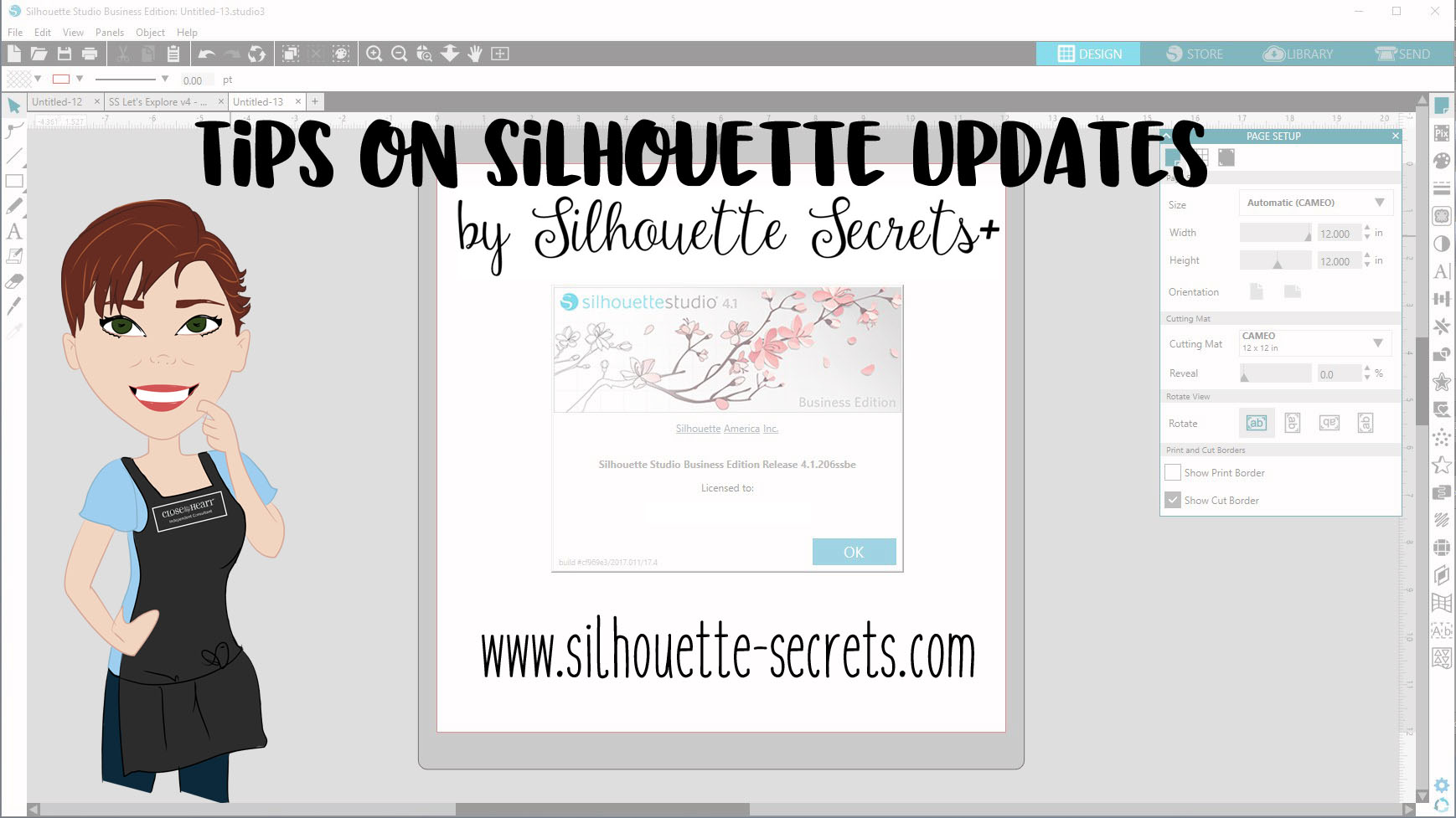
Tips on Silhouette Studio Updates

I see so many questions regarding Silhouette Studio Updates, so let’s discuss some information about a software update.

Update vs Upgrade

First, a Silhouette Studio update is different than a Studio upgrade.

Silhouette software upgrade is a product you can purchase that unlocks additional features in the Silhouette software. There are 3 levels: Designer Edition, Designer Edition Plus and Business Edition.

Upgrade

Check out this chart by Silhouette America on what features are unlocked with each upgrade. Click on the video camera icon next to each feature to see a short demo video.

Update chart

A software upgrade can be purchased from a Silhouette retailer such as Swing Design or direct from Silhouette America. The code can be either a digital code or a physical card mailed to you. I would suggest a digital code as it’s much faster and no shipping.

A software upgrade unlocks features that are already in the Silhouette software program. You can purchase the upgrade in steps or go directly to the one you want. For instance, if you have the Basic Software (free), you can go directly from Silhouette Studio to Business (the highest level) by purchasing the correct upgrade option.

A software update is something that makes changes to the actual program. An update is rolled out for many reasons such as adding new features or fixing a bug in a previous software version.

There is a lot of anxiety around a software update. So here are some tips about Silhouette software updates that I’ve picked up through using the software, teaching, and troubleshooting.

Tips for Silhouette Software Updates

  • Back up your Silhouette library. It is ALWAYS a good time to make a backup. Get in the habit of making a back up of the library monthly or weekly. This is especially important if you store your personal files in the Silhouette library.
    I highly recommend storing your personal files to an outside source or at the very least making a backup of the library. Just keep in mind that no place is 100% safe, so having multiple backups is a good idea too.

    This is direct from the Silhouette website regarding the Silhouette Cloud library “Silhouette America’s Cloud Storage is a syncing service rather than a backup service. Files deleted locally will be deleted on the cloud. We strongly recommend users save important and/or valuable files to another location outside of the cloud or local library, or to a third-party backup service.”

    I see so many users who say they’ve lost their designs and there can be many reasons for this happening.
    Another reason I highly recommend making a back up of your library and a back up of your external storage as well.Personally, I store all my files to an external hard drive which I also back up on a regular basis (probably should do it more than I do).

    To find out more information about the Silhouette cloud library click HERE to go directly to the Silhouette Cloud Overview.

    How do you backup the library in the v4.1 software?

    There are 2 sections of the Silhouette library – the Local User (computer specific) and the Cloud (email address & below). You must back these up separately.

    Local User

    Right click on the Local User section and choose Export. Save this file to a safe location. I like to save mine with the date included.

    Export Library1 copy

    Cloud (email address and below)

    Right click on the email address, choose Export and save this to a safe location. I add the date and ‘Cloud’ to the name of this file, so I can tell the difference in the files.

    Export Library copy

  • The “Check for Updates” option under the Help menu does not work. This will give you a message that there are No Updates available.Check for updates copy
  • Download the Silhouette updates direct from the Silhouette website. If you are prompted for an update through the software, I highly recommend that you choose Later and then when you are ready, update directly from the Silhouette website.Software update.JPG
    You can find the current software updates HERE on the Silhouette America site. Click on the option for MAC or Windows to download it to your computer.
  • Change how the software checks for updates. Under the Preferences you can change the Check for Updates option to Daily, Weekly, or Never.Preferences copy.jpgThe Preferences can also be found under the Edit menu in the top left corner or by using the keyboard short cut Ctrl + K.

    Preference menu

    Personally, I have mine set to “Never”. I can go out to the Silhouette America website and check if there are any software updates that have been released and download it directly.

    Once you change the Preference, then click the Apply and the Ok button.

    It is a complete personal preference on how you have the updates set to check.

Software updates are not bad.

There are many good reasons for an update. I love that the Silhouette software is such a powerful graphics program and it is amazing all that is included in this software. There are even more great things coming with the Silhouette Studio v4.2 release. It is still in the Beta testing phase and Silhouette is continuing to work to fix software bugs that pop up.

If you ever do get an update that has a bug you cannot live with or perhaps your software program updated to the Beta version, you can simply uninstall the Silhouette software from your Computer operating system and then reinstall the version you would like to roll back to.

Previous software versions can be found on the Silhouette America site under the Legacy section of the Software updates.

Legacy version copy

Do you have to update?

No.
You do not have to update your Silhouette software unless you want to. If you have the “Check for updates” set to Daily or Weekly, it will ask you when there is a new update if you want to update. If you are not paying attention or happen to share a computer with another person and the Ok gets pushed on the Update, the software will download the update.

If you choose not to update, you may not have access to all of the Silhouette features available to you. Features released are not retro-active, so if you would like access to new released features, you will need to update the software to at least the version where that feature was released.

Can you have multiple versions of the software installed?

Yes.
Something that not many do not know about is that you can have multiple versions of the Silhouette Studio installed on both a PC and a MAC.

I would not suggest this for the average user unless there is a specific reason that you want more than one version installed, such as downloading the Beta version to test it.

On a MAC, it will download another version with no additional steps needed. After the software downloads, you will need to make sure you change which Silhouette application is docked and make sure you are opening the correct version that you want.

On a PC, there are several steps and Kelly Wayment over at Finding Time to Create has a great post on this. You can find her post on “How to Install Multiple Versions of the Silhouette Studio – Windows 10” on her blog HERE.

I love how Kelly explains things. Kelly is also the voice behind many of the Silhouette America videos on Youtube, the writer behind the ebooks from Silhouette and many product videos for Silhouette.
If you have not seen the new Silhouette 101 blog, check it out HERE – there is lots of information on there.

Silhouette 101

Again, I would not recommend multiple versions for the average user. But, it can come in handy for certain reasons.

How do you have the Check for Updates set? Did you know you could change it?
I would love to hear – comment below or find me on my Facebook group at
Silhouette Secrets+ with EllyMae.

Enjoy!

SS_Signature copySS Logo snip it

**This post may contain affiliate links. What that means is that I may receive compensation if you purchase through the links I have provided. The price you pay for the product or service is not higher but I may get compensated for sharing.

Posted on 6 Comments

Let’s Explore v4 – Media Layout Setup Panel

Do you have the Business Edition upgrade? If not, there are so many neat features that are unlocked with it.
I have to admit that I have not used this much as all, but after today, that will be changing.

Media Layout Setup Panel

What is it? If you have the Business Edition upgrade this is an additional way to view your design to be cut and make some changes to it, without actually altering the design on the Design View.

So let’s explore the different views.

Design view is the normal view a user sees when the Silhouette software is opened.  The drawing tools are located on the left side, the panels are on the right side, and the document tools and Quick Access Tool bar are at the top.

Design view layout copy

Media view is an option if you have the Business Edition upgrade active on the software. This view shows how things are processed as they appear for a cut job. The Media view does not show color or patterns.

The Media Layout Setup Panel is found on the right side of the Silhouette Studio software, at the very bottom.

If you have a larger computer screen, you may see all the icons displayed on the right side like this.

Media view Panel copy

If you have a smaller computer screen, then you may have a fly out arrow to click on and then more icons will appear like this.

Media view small screen copy

The Media Layout view will open up with a split screen panel and you can choose between either side for which one is active and you are making changes in.

Media Layout View*Believe in the Magic of Christmas by Lori Whitlock – Design #162472

Now, let’s take a more detailed look at the Media Layout Setup Panel.

Media Layout Panel detail copy

  1. Show Media Layout Split – Screen – Check the box if you would like the Media layout to split screen with the Design View layout.
  2. Media Layout Setup Tabs – there are 4 tabs to chose from
    – Tab 1: Media Size, Cut Border & Orientation
    – Tab 2: Copy & Separation
    – Tab 3: Nesting
    – Tab 4: Tiling
  3. Media Size – Change the Page Size, Width & Height of the Media Layout ViewMedia Size
    You’ll notice that changes made on the Media Layout Screen do not change the Design View side on the left side. This is a way you can make changes to what will be cut without changing the actual Design mat itself.
  4. Cutting Mat – Change the Cutting mat size of the Media Layout View
  5. Reveal Mat – Slide the arrow over to reveal the cutting mat grid on the Media Layout ViewReveal mat copy
  6. Cut Border – Change the Cut border left, top, right, and bottom dimensions.Cut border copy.jpg

    As you can see above, on the right side the red cut border line changes as the measurements are changed under the Cut Border section.
    You could adjust these to where the material is placed on the mat or place it anywhere on the mat you like and it would only cut there.
    This might come in handy if the top left corner is no longer sticky but the middle of the cutting mat still has lots of stick left to it.

  7. Orientation – Rotate Cut Job – this will rotate the design on the cutting mat on the Media layout.Rotate cut
    Checking this box, will rotate the design 90 degrees on the cutting mat shown on the left side, but the original design stays in tact on the left side.While those features can be useful, I find the other tabs are even more interesting.

Media Layout Setup – Copy Tab

Next, is Tab 2 – the Copy Tab. Here is where you can tell the software to cut multiple copies of a design without actually adding images to the original Design mat.

Copies tab copy

  1. Copy rows – Add the number of rows you would like to cut and the Media Layout View will duplicate the design that many rows. It will show this on the right side in the Media Layout View only and leave the original design unchanged.Copy rows
  2. Copy columns – Add the number of columns you would like to cut and the Media Layout View will duplicate the design that many columns.Copy Columns
  3. Limit to Media – Click this button to limit the design to only the Media area selected, no matter how many columns or rows you enter, the software will change it to fit on only the Page Size and mat you have entered on the first tab.Limit Media
  4. Horizontal Separation – Increase or decrease the horizontal spacing between the designs on the selected media.Horizontal Separation copy
  5. Vertical Separation – Increase or decrease the Vertical spacing between the designs on the selected media.Vertical separation copy

This is another way you could tell the software to cut multiples of an image without actually having to Replicate the design on the Design view.

Either way will work, but it is another option and one I will be using in the future when cutting multiples of the same design.

Media Layout Setup – Nesting

And to add even more options to the Media Layout, the 3rd tab is the Nesting tab. This has several options in how it will nest the designs together before cutting.

Nesting tab copy

  1. Nesting Active – Check this box to turn the Nesting feature on.
  2. Interlock – The software looks for more paths to move shapes together. This works well for designs that are not square or hexagons.Here the Interlock is off:
    Interlocking off

    In this one, the Interlock has been turned on and you can see it Nests the design a little different.
    Interlocking on

  3. Maintain Grain – This option allows the design to rotate only 180 or not at all, in order to work with materials that may have a grain to them. So the design stays on the same grain of the material.
    For example, if you were cutting an object out of a wood grain paper and you wanted to make sure that the grain of the paper ran the length of a wood piece you were cutting instead of cross ways through it.
  4. Align – When align is on, the software will align the pieces of the design that are at an irregular angle.Here the Align is on:
    Interlocking on
    Notice the leaves are vertical.Here Align is off:
    Align option nesting
    Now the leaves are rotated to a different angle.
  5. Whole Words – Choose whether the software divides the text into a whole word or individual letters to place it for the cut.Here whole words is on:Whole words

    And here, whole words is off and it rearranges the individual letters:
    Whole words off

  6. Maintain Groups – When on, this maintains the items that are grouped together and treats it as one object. When off it will treat each piece as an individual object.Maintain Groups on:
    Maintain groups on

    Maintain groups off:
    Maintain groups off
    As you can see above, it treats it quite differently depending on what option you choose.

  7. Rotations Parameters – Tells the software how many rotations of an object is allowed when nesting it on the mat.This is 2 Rotations:
    Rotation parameters 2

    This is 4:
    Rotation parameters 4
    You can see above how it changes the spacing a bit when more rotations are allowed.

  8. Padding Parameters – This is the minimum distance between 2 shapes after it’s been nested.Here the padding is 1:Rotation parameters 4

    And here the padding is 3:

    Padding 3
    Once again, it changes how the nesting is done by the software.

This is just another way that shows the possibilities of the Silhouette software. I do learn new things everyday about what it is capable of.

So many projects to create, so little time to do it!

I hope you take advantage of the Media Layout Setup Panel in a future project.

I would love to see it on my Facebook group if you do.
Find me here at Silhouette Secrets+ with EllyMae.

Enjoy!

SS_Signature copySS Logo snip it

**This post may contain affiliate links. What that means is that I may receive compensation if you purchase through the links I have provided. The price you pay for the product or service is not higher but I may get compensated for sharing.

Posted on 2 Comments

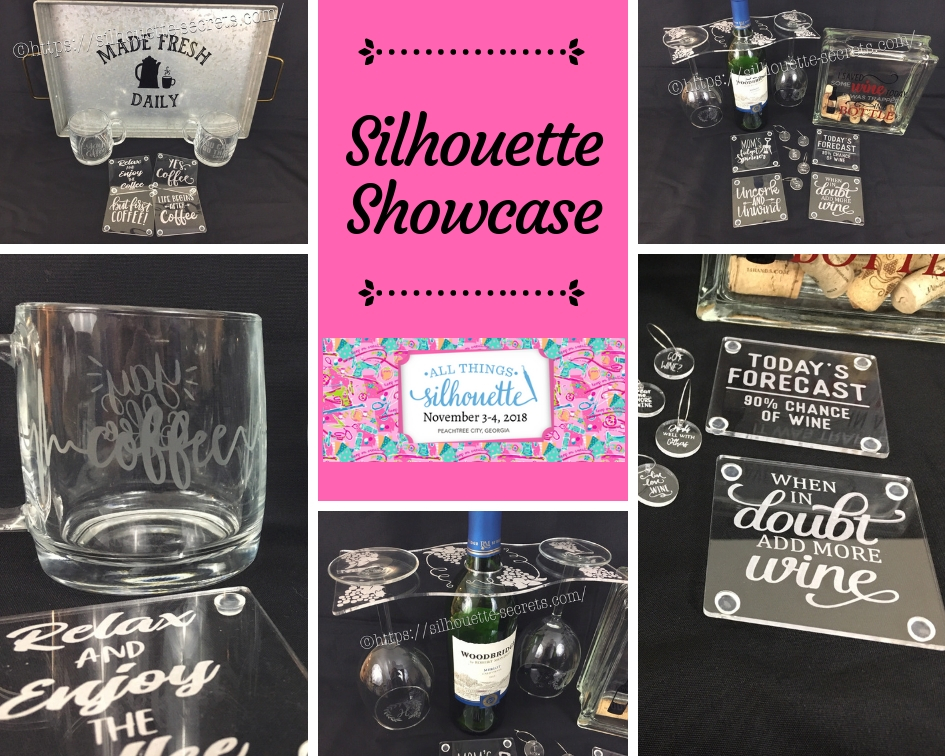
Silhouette Showcase

This year I am honored to be teaching several classes at the 2018 All Things Silhouette Conference hosted by Terri Johnson Creates. An option at the conference is participating in the Silhouette Showcase. This is a chance to show off things that you have made using your Silhouette machines or software and is open for all levels of users. Each person who enters gets an extra ticket to a prize drawing and while the staff is excluded from winning, we can display items in the hopes of inspiring others and showing all the possibilities with Silhouette.

I was so excited to be able to make up a few things to display during this event and wanted to share those with you.

Silhouette Showcase

Not sure what you start your day with, but mine is coffee.
So I started with this coffee inspired collection.

watermark_30-10-2018_05-07-37PM

Metal serving tray with Oracal 651 vinyl.
This design was created with Lori Whitlock’s Fresh Eggs fontDesign #263759 and Coffee Dingbats FontDesign #223050 using the Warp Feature in the Silhouette software. I use Oracal transfer tape for all my vinyl decal applications. Acrylic

Glass etched coffee mugs.
These glass mugs were purchased from Target and work well for etching. I used Oracal 651 vinyl for my etching stencil and Etchall cream for a great etch every time. For the mug on the left, I used Yay Coffee by Dawn Nicole Designs – Design #188578 and Coffee Pulse by Sophie Gallo – Design #149882. For the mug on the right, I used You Can Do This – Coffee by Jillibean Soup – Design #218802.

watermark_31-10-2018_10-58-37AM

Acrylic coasters etched with the Silhouette Curio machine.
I used the emboss panel in the Silhouette software to create the etched design.
These acrylic coasters can be found at Craft Chameleon and I would recommend purchasing the Curio template as well.
The designs used to create the coasters are:
Yes. Coffee by Kolette Hall – Design #171334
But First Coffee by Lilium Pixel SVG – Design #242962
Life Begins After Coffee Arrow Quote by Sarah Hurley – Design #258161
Relax and Enjoy the Coffee by Silhouette Secrets+ using History font by JumboDesign – Design #268580 and The Memories Sans Font Duo by Nursery Art – Design #276602.

watermark_31-10-2018_12-30-50PM

If you have followed me in my “Let’s Explore v4” series or on my Facebook page or group, you may know that I enjoy a glass of wine at the end of the day.
So of course, a wine collection set is right up my alley.

watermark_30-10-2018_05-07-06PM

Acrylic wine bottle caddy etched with the Silhouette Curio and the large Curio base.
This acrylic wine bottle caddy can be found at Craft Chameleon and the design file is included with the purchase of the acrylic blank. I would suggest the Curio large base template as well, it makes etching this blank so easy.

watermark_31-10-2018_11-00-00AM

Glass etched wine glasses.
For the etching stencil, I once again used the Oracal 651 vinyl and Etchall etching cream. The Monogram Wreath Font by Kristen Magee – Design #260225 was used to create these personalized glasses.

Wine cork collector.
This glass block was found in a craft store and Siser Easy PSV Merlot & black and Oracal 651 gray vinyl applied to the front.
The design is I Saved Some Wine Today Phrase by Kolette Hall – Design #131228 from the Silhouette Design Store.

watermark_31-10-2018_11-00-23AM

Acrylic wine charms etched with the Silhouette Curio.
These wine charms are 15/16″ clear acrylic circles and wine charm rings from Craft Chameleon.
Designs used to create the wine charms are:
Pour Me…. More Wine by Sophie Gallo – Design #203872
Live Love Wine by Kolette Hall – Design #158086
Drinks Well With Others by Kelly Lollar Design from SoFontsy
Screw It design – Freebie from Silhouette School
Got Wine design – created using the Buddy Mac font by Missy Meyer from SoFontsy

watermark_31-10-2018_10-59-39AM

Acrylic coaster etched with the Silhouette Curio machine.
These acrylic coasters from Craft Chameleon are a great way to personalize any gift.
The designs used on the coasters are:
Mom’s Fidget Spinner by Sweet Afton – Design #202772
Today’s Forecast 90% Chance of Wine by Jillibean Soup – Design #212800
Uncork and Unwind Arrow Quote by Sarah Hurley – Design #236620
Add More Wine by Megan Hardy Designs – Design #124514

For the Silhouette Showcase, a recipe is included with each display item.

I used the Silhouette Print and Cut feature to create recipes.

Print and Cut Coffee

Don’t forget when doing a print and cut, to select all the objects that you do not want to cut out and then choose the No Cut option on the Send Tab.
For instance, all I want is the outside edge to cut, so all the Cut lines except the outside edge need to be turned off.

Print and Cut coffee lines off

I started my Silhouette journey with paper crafting and continue to have a passion for it as well as all the other neat things you can do with it such as vinyl, glass etching & acrylic with the Curio, etc.

IMG_6482

I could have just left it at that, but of course, I didn’t. I added a little detail to the back that makes it stand up even more.

IMG_6483

This easel adds the perfect touch to my recipe, so I am easily able to transport it on the plane and display it at the Silhouette Showcase.
This is a file by Lori Whitlock called Easel for Back of CardDesign #76159 and I have used it many times when creating paper crafts.

SilhouetteShowcase

I hope you have enjoyed seeing the projects I created using my Silhouette software and machines for the Silhouette Showcase at the 2018 All Things Silhouette Conference.

Enjoy!

I love seeing what you are creating with your Silhouette machines!
Feel free to post on my Facebook group at Silhouette Secrets with EllyMae.

SS_Signature copySS Logo snip it

**This post may contain affiliate links. What that means is that I may receive compensation if you purchase through the links I have provided. The price you pay for the product or service is not higher but I may get compensated for sharing.

Posted on 14 Comments

Let’s Explore v4 – Emboss Panel

The Emboss Panel is such neat feature. Currently, it is only available to those who have plugged in a Curio machine.

It can be found on the right side of the Silhouette Studio v4 software and looks like a star with a shadow.

Emboss panel copy

Since this is a currently a Curio feature only, if you have not plugged a Curio into your computer, the Panel will be grayed out. If you hover over the icon, you get this message.

Emboss warning

So keep that in mind if you are looking at it along with me.

Emboss detail copy
  1. Deboss – the design will be created as seen on the screen & will press the design down into the material exactly as seen on screen.
    For example, if using cardstock, it will create a valley where the design is.
    Emboss – the design is flipped horizontally so it is mirrored BUT it does not show this on the screen. You will place your material face down on the embossing mat and the design will be pressed mirrored. When it’s finished, you will flip it over and the design should be raised on the side that was face down on the mat.
  2. F – This tells you which way to put the material on the mat. For deboss, put the material face up.
    F Deboss
    For emboss, put the material face down.
    F Emboss
  3. Embossing Patterns – Choose between 5 options: none, lined, concentric, cross hatched, or spiral.
    Lined
    Line Pattern
    Concentric
    Concentric Pattern
    Cross hatched
    Cross hatched pattern.JPG
    Spiral
    Spiral
    Each design will vary in which pattern may look better for the emboss. Again it is a matter of personal preference. I prefer the look of the cross hatched pattern, especially when etching on acrylic. But, that is just my preference, you should play with the patterns and decide what you like.
  4. Spacing – Increase or decrease the grid spacing between the lines of the pattern. This is 0.005 spacing – a really tight DebossSpacing smallIf we zoom in on the design, you will see the pattern.
    Spacing small zoom

    Here the deboss is 0.025.

    Spacing larger

    This is another area where you are changing a lot of data at one time, so be patient with your computer if it is thinking.

    If the pattern spacing is smaller than what the Silhouette can process, then you will end up with a blue square or a square with an X in it.

    Error spacing
    Use the up arrow and increase the spacing just a bit or delete and type in a number just a bit higher than the current spacing, until the box disappears. Remember, be patient and go slow, it is processing a lot of data.


    Above 0.015 was too small but increasing to 0.025 there was no longer the error.

    Error spacing2
  5. Angle – Change the angle of the deboss or emboss pattern.
  6. Release Emboss – Releases the lines of the emboss pattern. When you are satisfied with the pattern, click on the Release Emboss button.Once the emboss/deboss is released, you could add another pattern on top if you chose to.

Here is the flower design (Floral Elements Design #191146) embossed on a piece of Silhouette Score & Emboss paper. This was embossed using the Silhouette fine tip embossing tool and 3 different embossing patterns.

Flower emboss

Now, while I have not been that impressed with the emboss ability on cardstock, it is just not deep enough for my liking,  I do love using the emboss features on materials such as metal and acrylic.

Silhouette Metal Etching Sheet
Metal etching 2
Home Sweet Home Montana by Jennifer Wambach Design #148502

Metal etching 1
Welcome Elk by Sophie Gallo Design #89012

Acrylic

acrylic etching
Acrylic coaster blanks from Craft Chameleon
Eat, Sleep, Coffee Repeat by Sophie Gallo Design #230872
Less Monday More Coffee by Tany Batrak Design #209927
Yes, Coffee by Kolette Hall Design #171334
But First Coffee by Lilium Pixel SVG Design #242962

I hope you have learned a little bit about the Emboss Panel today. The Curio machine very quickly because a favorite of mine and now I can’t put it away.

Here are a few more a things to help you get started on the Curio.
The Curio – Getting Started with the Curio
Silhouette Curio Beginner Metal Etching
Basic Acrylic Etching Video Class

I’d love to see what you are creating with your Silhouette machine.
Feel free to post over on my Facebook group at Silhouette Secrets with EllyMae.

Enjoy!

SS Logo snip it

**This post may contain affiliate links. What that means is that I may receive compensation if you purchase through the links I have provided. The price you pay for the product or service is not higher but I may get compensated for sharing.

Posted on Leave a comment

Let’s Explore v4 – Advanced Rhinestones

There are so many neat features of the Silhouette Studio software as you move up in the software upgrades. The Advanced Rhinestone Panel is an option if you have the Designer Edition Plus or Business Edition upgrade.

Rhinestone Panel copy

At first glance or if you read the standard description, it may not seem like much of a feature, but let’s take a look at it more in depth.

Rhinestone Panel Detail copy

  1. Rhinestone Library – Contains images of rhinestone designs – 2 sectionsPre-set Images and Sizes – Choose which color and size that you would like to add to your design

    Rhinestone options

    User Rhinestones – designs can be added to the Rhinestone library by either drawing a shape or importing a photo

    Rhinestone Library - User section copy

  2. Size – Designates the size of the rhinestone chosen or the size of the rhinestone design you are creatingSize copy
    This will show grayed out if using a pre-set shape & size.

    If a shape is added to the rhinestone library, then a size can be designated and it is no longer grayed out.

    Size User created copy

  3. Add Selected Shape to Rhinestone Library – Add shape designs to the library for creating a new rhinestone option. Shapes can be drawn or imported from a photoAdd Selected Shape copy

    The default measurement can also be changed under the Preferences in the software. It can be set to inches (default), millimeters, centimeters, meters, inches or feet.

    Change measurement preference copy

    And then it will reflect in the panels that use measurements.

    Change measurement copy

    If the shape drawn is bigger than what is allowed, a pop up will appear stating this.

    Error size

  4. Draw Rhinestones – Single vs Multiple – Choose to draw one style of rhinestone designs or a multiple of designs from the library.Single – drawing rhinestone in repeat of 1 shape with a click of the mouse

    Draw Rhinestone Single click

    Multiple – Draw Rhinestone from a chosen list of varied designs pulled from rhinestone library.

    By clicking on the multiple option, a new option window expands and you can add or delete the order of the designs in the selection window.

    Draw Multiple pattern
    This would come in handy if you are trying to create a rhinestone pattern with different sizes.

    Or you can use the pre-set rhinestone designs and create a pattern too.

    Draw Multiple pattern on shape

  5. Angle – Change the angle of how the rhinestone design follows a shape.Standard = Rhinestones upright
    Center = Rhinestones point to center
    Perpendicular = Rhinestone align to contour

    Angle

  6. Spacing – Change the spacing between the rhinestones when applied to a shape.Spacing.JPG
  7. Angle Offset – Choose what angle the rhinestones are placed along a shape.Angle Offset.JPG
  8. Rhinestone placement – Choose how the rhinestones are placed – options are: Outer edge, perpendicular, or from center.Rhinestone Placement
  9. Draw Rhinestone – Single Click vs Replace – Add a rhinestone with a single mouse click or replace a rhinestone with a different rhinestone.Single = place 1 rhinestone with each click of the mouse
    Replace = Once a rhinestone is placed it can then be swapped out with a different rhinestone for another size or color
  10. Totals (All Shapes) – Gives a count of all the rhinestones on the mat or the image selected.Totals copy

 Now that we have explored the entire panel – what would you use this for?

Here I’ve created what is called a mock up and the design is laid on top of the photo of the tote bag.

Mock up photo

Now I may actually have to make the rhinestone decal for real.
Find out more information on creating a rhinestone template in the Let’s Explore v4 – Rhinestones post.

Have you played with the Rhinestone feature yet?
I would love to see your Silhouette projects! Feel free to post on my Facebook group at
Silhouette Secrets+ with EllyMae.

Enjoy!

SS_Signature copySS Logo snip it

**This post may contain affiliate links. What that means is that I may receive compensation if you purchase through the links I have provided. The price you pay for the product or service is not higher but I may get compensated for sharing.